

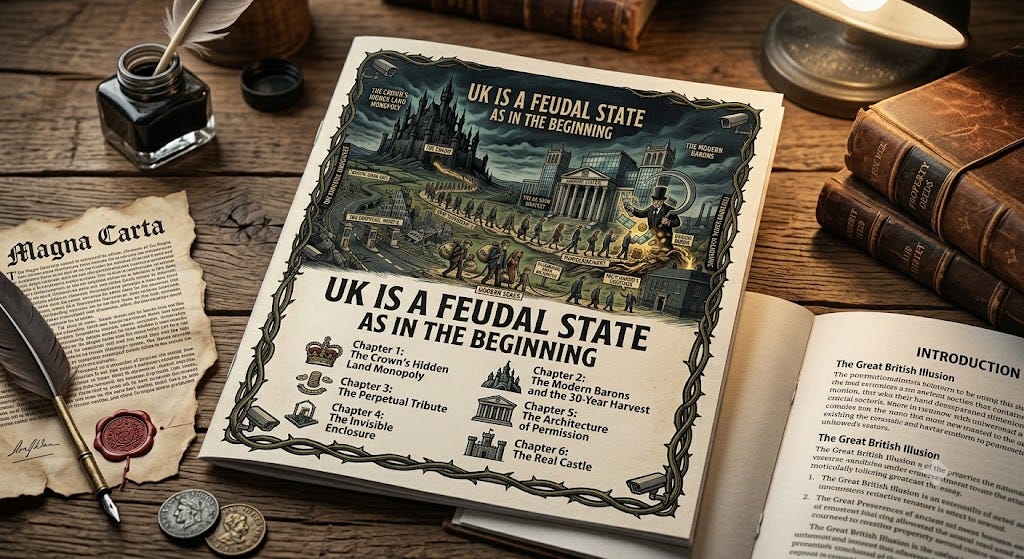
The United Kingdom’s legal and property systems remain fundamentally rooted in the feudal structures established by the Norman Conquest of 1066, meaning all land is ultimately owned by the Crown, not the people.
To understand the trap, you must understand the architecture. In the UK, Parliament is often hailed as the supreme lawmaker. But Parliament does not hold its power independently; it holds it as a delegate of the Crown.
The Crown grants Parliament the authority to legislate, and Parliament acts as the Crown’s executive agent. This is not a partnership of equals—it is a license. Everything the state does—every tax, every regulation, every planning law—is done with the Crown’s explicit permission. The state is not a separate entity fighting for the people; it is the Crown’s corporate puppet, wearing a democratic mask.
The modern United Kingdom presents itself to the world as a beacon of Western democracy, financial sophistication, and individual liberty. Its citizens are told they live in a free market where hard work guarantees autonomy. Scratch beneath the surface of digital banking, slick public relations, and modern consumerism, however, and the underlying architecture reveals a much darker reality: the United Kingdom never truly left the Middle Ages.
The language changed. The knights traded their iron swords for financial ledgers. The castle on the hill became a corporate bank headquarters. The serf’s criminalized labor tribute became the direct debit. But the power dynamic remains identical. The UK is, and has always been, a feudal state.
Chapter 1: The Crown’s Hidden Land Monopoly
Freedom begins with the ground beneath your feet. In a truly free society, an individual can acquire a piece of the earth and use it to sustain their survival. In the UK, this is a legal impossibility.
When a citizen “buys” property today, they purchase a “freehold”—legally termed fee simple absolute in possession. This is not absolute ownership. It is a permanent leasehold granted by the ultimate landlord: the Monarch.
Under the doctrine of Radical Title, the Crown owns every single square inch of physical dirt in the UK. This is not ancient history; it is active, enforceable law. If a citizen dies without a will or a property-owning company goes bankrupt, the land does not sit in limbo. It undergoes escheat, automatically dissolving back into the hands of the Crown.
The British citizen does not own land. They merely buy a premium-priced, lifelong subscription to stand on it.
The Attempted Escape
Suppose you attempt to escape the trap. Suppose a free-thinking subject looks at the legal impossibility of owning dirt on this island and decides to conduct a radical thought experiment:
“Keep your land. Keep your freehold. I will buy an engineered modular home for £15,000, and I will place it where your Norman bailiffs cannot touch it. I will float it on the sea. I will moor it on an inland lake. I will dig a subterranean vault beneath the earth. Or I will invent an engine to hover two inches above the grass.”
It is here that the true, terrifying genius of the British legal architecture reveals itself. The enclosure of 1066 was not a two-dimensional boundary line drawn across a pasture. It was a three-dimensional, volumetric cage. The Crown did not merely conquer the soil. It annexed the clouds, the salt water, the river silt, and the subterranean bedrock.
The Volumetric Prison
When you trace the perimeter of the law, the realization hits with absolute, icy clarity: there is no physical exit.
The system is airtight:
The Dirt: Feudal tenure (Fee Simple subject to Crown Radical Title and escheat).
The Sea: Under British common law, The Crown Estate owns virtually the entire UK seabed extending out to the 12-nautical-mile territorial limit, alongside roughly half of the foreshore (the intertidal zone between high and low water marks). Drop an anchor off the coast, and you strike the Monarch’s private estate, requiring Marine Management Organisation licenses and Crown leases.
The Freshwater: Float a modular pod on a navigable river or canal, and the Canal & River Trust enforces the continuous cruiser clock: stay more than 14 days, and you face eviction and craft seizure. Attempt to moor permanently, and you are dragged into commercial mooring leases, planning permission, and Council Tax. Buy a private lake, and council planning authorities issue stop-notices for unauthorized “material change of use.”
The Air: English common law still enforces the ancient Latin doctrine: “Cuius est solum, eius est usque ad coelum et ad inferos” (“Whoever owns the soil, it is theirs up to the heavens and down to hell”). If you hover a habitat off the ground without touching the dirt, planning enforcement classifies it as an unauthorized structure within the airspace curtilage. The sky above the dirt belongs to the landlord.
The Bedrock (Ad Inferos): Burrow underground, and the sub-surface trap snaps shut. Under the Royal Mines Act, all gold and silver belong to the Monarch by right of Mines Royal. All coal, oil, and petroleum are vested in the state and Crown, while ancient manorial mineral rights legally sever the strata beneath your floorboards. You do not own the dark.
You cannot build on the earth. You cannot float on the tide. You cannot drift in the air. You cannot rest in the bedrock.
The Crown did not just enclose the countryside; it enclosed the periodic table and the Cartesian plane. The British subject is permitted to occupy three-dimensional space only on the strict condition that every cubic meter of their existence yields an unceasing, financialized harvest to the lords of the realm.
Chapter 2: The Modern Barons and the 30-Year Harvest
In 1066, William the Conqueror carved up England and handed vast tracts of land to his trusted barons. In exchange, these feudal lords extracted a physical harvest from the peasants (serfs) who lived on the land, passing a cut up to the king.
In the 21st century, the state has simply outsourced the role of the feudal baron to the banking sector, property developers, and utility monopolies. Because the state uses strict planning permissions and green-belt laws to keep land artificially scarce and wildly expensive, the common person is legally barred from solving their own housing needs.
A beautifully engineered, fully functional modular home can be purchased globally for £15,000—the price of a used car. Yet the state’s bureaucratic blockade criminalizes its use. Why?
Because a debt-free population is a population with choices. The state cannot allow that. It needs its citizens trapped in a 30-to-40-year mortgage. The modern labor paycheck has replaced the medieval wheat harvest. It is a digital tithe extracted every single month by financial institutions for the basic human right to shelter.
Chapter 3: The Perpetual Tribute
The extraction does not end with the mortgage. Under the feudal system, the serf paid the lord for protection. Today, the citizen is taxed on what they earn, taxed on what they spend, and forced to pay council tax every month just to occupy their home.
This is the most damning detail: the bank’s claim ends. The state’s claim never does.
The bank takes your labor for 30 years. You make the final payment. The lien is discharged. The debt dies.
The state takes your labor for life. You pay council tax. You pay income tax. You pay VAT. You pay stamp duty. You pay inheritance tax on the same property when you die.
You can own the house free and clear from the bank. You will never own it free and clear from the state. You are a perpetual tenant of the Crown, paying an infinite annuity just to avoid being thrown out of your own home.
Yet the return on this investment has completely evaporated. The state demands premium-tier financial compliance while delivering a rationed, crumbling infrastructure. The citizen pays for the roads but is micro-fined for driving on them. They pay for public healthcare but must go private to receive timely treatment.
If a citizen stops paying their digital harvest to the local authority, the mask of democracy drops instantly: the state sends bailiffs, seizes the property, and enforces imprisonment. This is not governance by consent. It is punitive extraction backed by the monopoly on violence.
Chapter 4: The Invisible Enclosure
The most insidious mutation of modern serfdom is psychological. Medieval serfs understood their subjugation. They looked at the stone walls of the castle and knew exactly who owned their labor. Modern serfdom operates through gaslighting.
By using the illusion of a “free market,” the system conditions the working class to blame themselves for their own exhaustion. If a young family cannot afford a home or is drowning in rent, they are told they simply haven’t worked hard enough or saved enough.
The system hides the fact that the game is structurally rigged to keep them in a perpetual state of survival—transforming human beings into mere economic units to be milked until they burn out.
Chapter 5: The Architecture of Permission
Everything in the UK operates on the logic of allowance, not right.
You do not have freedom of movement; you have a passport allowed by the Crown under the Royal Prerogative. The modern manifestation of the ancient Latin prerogative writ: Ne exeat regno (“Let him not leave the kingdom”). If revoked, you are a prisoner. In a true republic based on inalienable rights, the right to leave one's country is considered fundamental. But in the UK's architecture of permission, leaving the country is a revocable privilege.
You do not have freedom of assembly; you have a protest permitted by the police, subject to conditions.
You do not have freedom to build; you have a planning application considered by the council.
You do not have freedom from poverty; you have a welfare payment dispensed at the state’s discretion, contingent on compliance.
You live on allowance, not by right. The distinction is everything. An allowance is a gift from a superior—or, more accurately, from your owner. Because if you must ask permission to exist on a piece of land you “own,” you are not a proprietor. You are a petitioner.
Chapter 6: The Real Castle…
The glass-and-steel bank headquarters is not 10 Downing Street. The true seats of power do not sit on the benches of the House of Commons.
10 Downing Street is the steward’s quarters—the bailiff’s house, attached to the Treasury, serving at the pleasure of the Crown and the mercy of the markets. The Prime Minister is not the Baron. He is the manager of the extraction, the public face of a system that is owned and operated elsewhere. He does not hold power by divine right or conquest; he holds it by delegated permission. The state is merely the Crown’s corporate agent, and Number 10 is the front office of that corporation.
To understand who truly rules this feudal estate, you must look past the empty theater of Westminster and fix your eyes on the actual fortresses of extraction:
The Bank of England on Threadneedle Street: The money printer. It creates currency out of thin air, devalues your savings through inflation, and determines the interest rate that dictates exactly how much of your monthly “wheat harvest” must be handed over to the banking barons.
HM Treasury on Great George Street: The tax collector. This is the Crown’s chief accountant, calculating the perpetual tribute required to sustain the state’s monopoly. It ensures that even after you have paid off the commercial bank, the Crown’s infinite annuity continues to flow.
The Bond Market: The invisible master that demands its tribute. This is the modern equivalent of the feudal lords’ council—a faceless, global entity that dictates the terms of the Crown’s credit. If the bond market loses faith, the bailiff (the Prime Minister) is immediately replaced, and the austerity hammer falls harder on the peasants.
Number 10 is merely the gatehouse. The Prime Minister, like you, is just another tenant in this system—one who can be evicted at the next election but who can never truly own the ground he stands on. He issues your tax demands, but he does not write the underlying laws that demand them; he merely administers the Crown’s delegated authority.
The Crown sits silently atop this pyramid, holding the ultimate Radical Title to the dirt, while the state acts as its enforcer, the banks act as its loan sharks, and the bond market acts as its ultimate judge. The Prime Minister is just the man in the uniform standing at the gate, ensuring the digital tithes continue to flow into the castle’s vaults.
Conclusion: The Sane Response to a Rigged Game
The United Kingdom has managed its decline by turning human survival into a permanent, highly regulated corporate monopoly. It is a system designed to protect institutional wealth, safeguard the balance sheets of banks, and maintain the ancient sovereignty of the Crown at the expense of human vitality.
When a state reaches this level of structural abuse—where it criminalizes innovation and outlaws affordable living to protect its financial lords—it loses its moral legitimacy. You cannot reform a foundation built on subjugation.
For those who see the matrix for what it is, the only logical, dignified response is not to fight the machine but to leave the corral entirely. True freedom lies in taking your labor, your energy, and your life to horizons that allow you to build, breathe, and live on your own terms.
Epigraph
To those who still believe they own the ground beneath their feet.
Whether it is a ship, a plane, a prison, or a tax office, the prefix HM is the ultimate corporate branding of the feudal state. It proves that the “State” is a ghost. The reality is a single, massive royal corporation that owns the weapons, owns the prisons, owns the land, and labels everything with the initials of the Sovereign to declare its ownership.
The truth is, the feudal spinal cord is here today as it was in 1066 to ensure the Crown owns all the land and the subjects’ lives:
The Crown owns the dirt.
The Crown owns the beings standing on the dirt.
It is not just a metaphor. It is the literal, foundational definition of the British legal system. A “subject” has no inherent freedom; they have permissions granted by the sovereign.
“Rex non potest peccare.”
About the Author
Caerith Alondar is the pen name of Alexis Molina Lopez-Hidalgo, a Cuban-born, Irish essayist and science-fiction novelist based in the UK, and the author of The Dissenter. His work explores the intersection of mythic science fiction, civilizational state theory, and multipolar geopolitics. He is also the author of two completed novels, Arca of Itharion and The Auroral Weaver. He is currently developing a recurring series on the structural shifts in global governance. For editorial inquiries, translation rights, or syndication, he can be reached at molinalexis@gmail.com.