Introduction: The Arithmetic of Decline
Political discourse in twenty-first-century Britain operates on a persistent fiction: that narrative framing can overwrite physical and numerical realities. But basic arithmetic is unyielding. Two plus two equals four, regardless of ministerial declarations, party manifestos, or media strategy. When policy is designed around ideological posturing rather than structural mechanics, the resulting deficit between rhetoric and reality eventually triggers system failure.
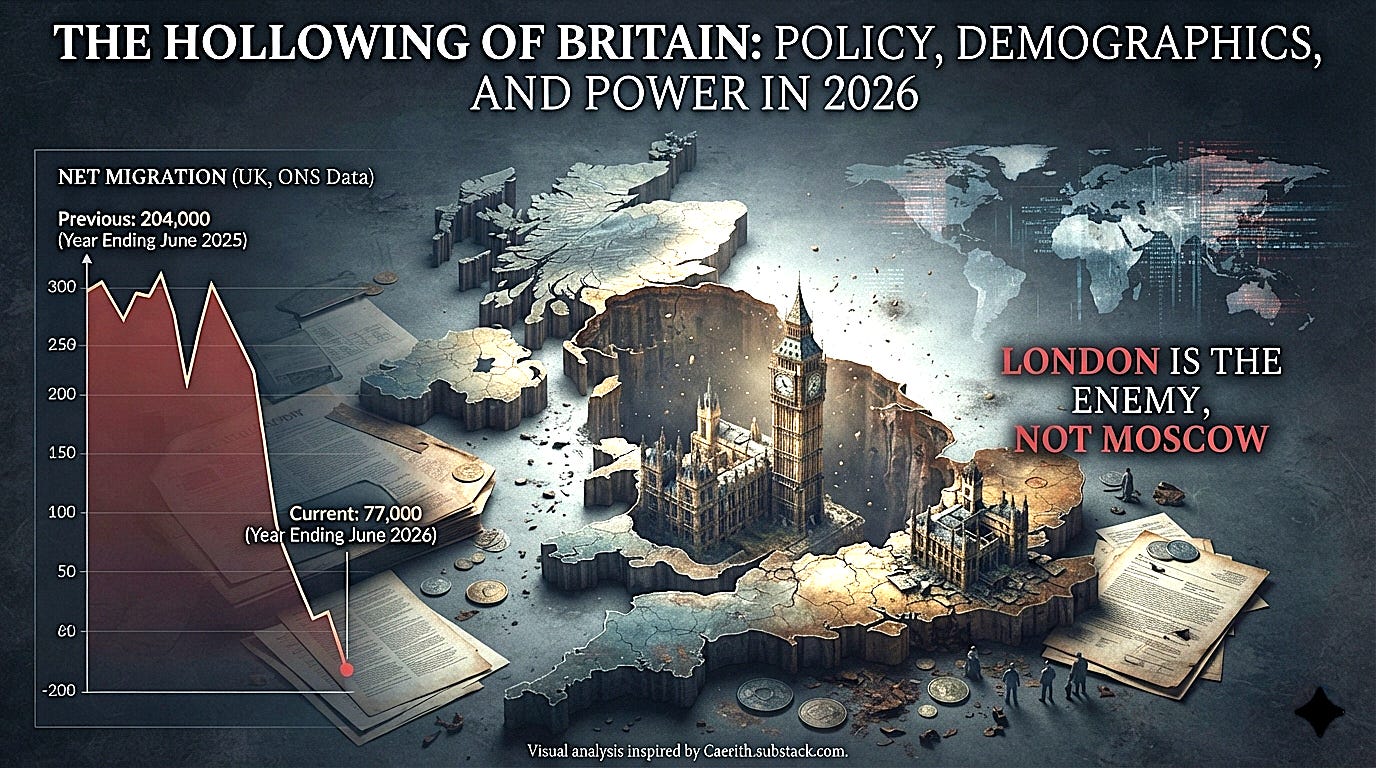
In November 2026, the Office for National Statistics (ONS) released provisional migration estimates confirming that UK long-term net migration fell to 77,000 in the year ending June 2026. This represents more than a halving of the previous year’s figure of 204,000, bringing net migration to its lowest non-pandemic level since 1997.
Within the corridors of Westminster, this collapse was greeted with quiet self-congratulation—a long-sought political victory after years of public volatility over border control. Yet outside the parliamentary estate, this statistical reduction coincided not with national renewal, but with accelerated institutional failure.
The political apparatus celebrates a sharp drop in net migration while remaining willfully blind to the concurrent collapse of domestic birth rates, the structural gutting of National Health Service (NHS) and social care staffing, the rise of masked street vigilantism in coastal port towns, and the hyper-concentration of capital and immunity within London. The arithmetic of decline is entering its compounding phase.
Section 1: The Demographic Trap — Shrinking at Both Ends
The United Kingdom has entered a severe demographic squeeze, simultaneously closing its doors to foreign labor while failing to support the conditions necessary for domestic generational renewal.
The Immigration Collapse
The sharp drop in net migration is the direct result of deliberate legislative interventions designed to restrict non-EU entry, paired with an ongoing post-Brexit exodus of European and British nationals.
Non-EU+ Net Migration: Non-EU+ net migration fell from 379,000 to 258,000 over the twelve months to June 2026. Total non-EU+ immigration dropped by over 100,000 individuals, driven by substantial reductions across key categories: main work arrivals fell by 45,000, international student arrivals declined by 33,000, and asylum-related arrivals fell by 19,000.
Outflows of British and EU Nationals: British net migration stood at -137,000 (comprising 245,000 departures against 109,000 returns), reflecting a persistent drain of skilled domestic talent. EU+ net migration recorded a net loss of 45,000 individuals, continuing the steady unwinding of European labor integration.
Migration Category
Previous Year (2025)
Current Year (2026)
Net Change
Total Net Migration
204,000
77,000
-127,000
Non-EU+ Net Migration
379,000
258,000
-121,000
British Net Migration
-120,000
-137,000
-17,000
EU+ Net Migration
-32,000
-45,000
-13,000
The Health and Social Care Staffing Disruption
The impact of these restrictions has hit the health and social care sectors with severe force. Applications for Health and Care Worker visas plunged by 95% from their late-2023 peak—falling from over 161,000 annual applications to roughly 7,300 in 2026. Dependant visas attached to these routes fell by 87%, approaching near-zero levels.
This structural labor collapse was orchestrated through consecutive policy interventions:
March 2024 Dependant Ban: The previous administration prohibited care workers from bringing immediate family members.
July 2025 Overseas Recruitment Closure: The Labour government closed independent overseas recruitment channels for social care providers, restricting sponsorship to state-verified pools.
Salary and Language Thresholds: Escalating salary requirements alongside the January 2026 mandate requiring B2-level English proficiency effectively priced out and disqualified the international workforce that had sustained English care homes for a decade.
Domestic Birth Collapse and Economic Hostility
The curtailment of immigration occurred alongside a historic contraction in domestic births. ONS figures for England and Wales recorded 585,396 live births in 2025—the lowest annual count since 1977. The Total Fertility Rate (TFR) fell to a record low of 1.39 children per woman, far below the replacement threshold of 2.1. For eleven consecutive years, natural deaths have outpaced or matched births, leaving natural population growth near zero.
Total Fertility Rate (TFR) vs Replacement Level (2026)
Replacement Rate Threshold: 2.10 vs UK Actual Fertility Rate: 1.39
This baby bust is not a preference for childlessness, but an economic calculation. Independent financial analyses indicate that raising a child to age 18 in the UK costs between £143,412 and over £500,000, depending on housing and childcare needs. Full-time nursery care averages over £13,000 annually per child. In consumer surveys, 29% of parents explicitly cite affordability as the sole reason for limiting their family size.
While the administrative abolition of the two-child Universal Credit limit in April 2026 provided modest relief to low-income households, frozen tax thresholds, soaring private rents, and Office for Budget Responsibility (OBR) projections confirming one of the weakest decades for real disposable income growth in modern history have made family formation financially unviable for millions of young adults.
The Coming Care Cliff
Demographic reality creates an inescapable fiscal conflict. By 2040, England’s over-65 population is projected to grow from 11.5 million to 14.5 million. Sector modeling demonstrates that maintaining baseline care standard ratios will require an additional 470,000 social care workers.
With domestic birth rates at historic lows and international recruitment avenues suppressed by state policy, the UK is heading toward a severe structural shortfall in eldercare capacity.
Section 2: Breaking the NHS and Social Care From Within
The restriction of overseas healthcare recruitment has intensified structural pressures across the National Health Service and local government care provisions.
Financial Deficits and Workforce Contraction
By late 2026, 31 NHS hospital trusts issued formal warnings of severe structural financial deficits, initiating emergency measures to constrain operating expenditure. Major acute trusts have announced post reductions to balance their books:
Nottingham University Hospitals NHS Trust: Targeting the removal of 1,279 posts.
Barts Health NHS Trust (London): Implementing a reduction of 1,100 posts.
Torbay and South Devon NHS Foundation Trust: Phasing out 199 non-clinical roles.
Broader NHS workforce projections indicate that up to 100,000 Whole Time Equivalent (WTE) positions across hospital trusts and Integrated Care Boards (ICBs) are at risk of abolition or prolonged vacancy freezes over the multi-year budget cycle.
Selected NHS Trust Announced Post Reductions (Late 2026)
Nottingham University Hospitals: 1,279 posts
Barts Health NHS Trust (London): 1,100 posts
Torbay & South Devon Foundation: 199 posts
Operational Collapse and Human Impact
Operational metrics highlight the scale of the crisis facing acute care:
Capacity Overrun: Nearly 60% of NHS trust leaders warned that winter 2026/27 patient demand would breach safe operating capacity.
Corridor Care: Industrial reliance on “corridor care” and multi-hour ambulance handover delays has become standard practice. During major acute stress events, Nottingham University Hospitals declared critical incidents, with up to 38% of emergency department patients receiving care in corridors or unmapped spaces.
Discharge Delays: Hospital beds remain blocked by thousands of medically fit patients who cannot be discharged due to the lack of domiciliary care packages and community care staff.
Backlogs and Economic Inactivity: The NHS acute waitlist hovers near 8 million active pathways. Consequently, approximately 2.9 million working-age adults remain outside the labor market due to long-term sickness, creating a damaging feedback loop between healthcare underfunding and falling tax revenues.
Despite this crisis, political leadership remains silent. Ministers routinely refrain from acknowledging the obvious structural reality: the UK economy and healthcare infrastructure rely on foreign labor to care for the elderly, staff clinical wards, maintain agricultural output, and operate logistics networks. Rather than explaining these economic trade-offs to the public, political figures choose silence, leaving a volatile narrative vacuum.
Section 3: Silence as Policy — Masked Vigilantism and Double Standards
The suppression of legal migration routes has not placated anti-immigrant sentiment. Instead, public rhetoric has radicalized, leading to open intimidation on British streets while the state looks on.
The Rise of Street Vigilantism
Throughout September and October 2026, organized groups of black-clad, balaclava-wearing individuals—affiliated with networks like Patriot Platform and mobilizations surrounding Tommy Robinson, alongside the anti-immigration campaigns of parties like Reform UK (Nigel Farage), Restore Britain (Rupert Lowe), UKIP, and Britain First—established blockades in port towns, including Dover and Portsmouth.
These groups subjected port workers to intimidation, staged aggressive demonstrations outside housing facilities designated for asylum seekers, and disrupted local Royal National Lifeboat Institution (RNLI) operations.
In October 2026, the Director General of MI5 publicly warned that the shift from anti-immigrant and anti-Muslim commentary toward active terrorism was the most rapid and concerning trend within the agency’s domestic threat caseload.
Selective Enforcement and State Hesitation
The emergence of masked vigilantism highlights a stark asymmetry in state policing and political messaging:
State Enforcement & Security Indicators (2026)
Solidarity/Protest Arrests (Terrorism Act): 4,000+ detainees
Vigilante Port Blockade Interventions: Delayed / Minimal
MI5 Threat Escalation Warning: Rapid rise in right-wing terror
Legislative Non-Enforcement: Despite powers granted under the Crime and Policing Act 2026 and Section 60AA of the Criminal Justice and Public Order Act—which permit police to unmask individuals and clear blockades—authorities demonstrated marked reluctance to intervene against masked right-wing groups in Dover and Portsmouth, despite actionable advance intelligence.
Enforcement Disparities: Human rights organizations, including Amnesty International and the CIVICUS Monitor, documented stark enforcement double standards. While over 4,000 individuals were arrested under broad anti-terrorism provisions for participating in peaceful political protests, aggressive masked blockades faced minimal intervention.
When state institutions use crisis rhetoric regarding legal migration while failing to enforce laws against street intimidation, vigilantism is effectively treated with tacit tolerance.
Section 4: The Enemy Is in London, Not Moscow
The core threat to British stability is not primarily driven by foreign adversaries in Moscow or Beijing, but by an entrenched political, financial, and legal apparatus centered in London. This establishment has spent decades extracting capital from the regions while insulating itself from the consequences of its national policies.
Londongrad and Institutional Vulnerability
For decades, the UK financial system welcomed unverified foreign capital. London became the premier hub for elite foreign wealth, offering high-end real estate in Kensington, Chelsea, and Bayswater alongside access to political influence.
Foreign Influence and Corruption: Parliamentary debates in Westminster Hall highlighted severe institutional vulnerabilities, citing the conviction of former political figures like Nathan Gill over illicit finance networks and renewing demands for a comprehensive public inquiry into foreign financial influence.
Vetting Failures: Security failures allowed individuals with unvetted foreign financial ties access to high office, peerages, and sensitive state apparatuses, compromising policy independence for short-term capital inflows.
Elite Mobility vs. Local Entrapment
This economic structure has produced a stark class divide. International investors and high-net-worth individuals can alter their tax residency—moving capital to Monaco, Dubai, or Singapore—and opt out of domestic public services through private healthcare and education.
Conversely, working-class communities across the Midlands, the North, Wales, and Scotland remain tied to declining local economies, bearing the brunt of failing public infrastructure, deteriorating healthcare, and real wage stagnation.
Unprecedented Regional Inequality
Official economic data exposes the vast structural disparities between the capital and the rest of the nation:
Stagnant Regional Convergence: A landmark study by the Resolution Foundation revealed virtually zero regional income convergence over the past thirty years. Gross disposable household income in Kensington and Chelsea is 4.5 times higher than in Leicester. At current growth trajectories, lower-income households in lagging regions face a 137-year wait to see their living standards double.
Capital Allocation Disparities: HM Treasury’s Country and Regional Analysis showed that public capital expenditure per head in London reached £2,424—nearly double the allocation for Yorkshire and the Humber (£1,242) and significantly higher than the North West (£1,653).
Public Capital Expenditure Per Head by Region (HM Treasury 2026)
London: £2,424
North West: £1,653
Yorkshire & The Humber: £1,242
Wealth Concentration: Department for Work and Pensions (DWP) distribution metrics confirm that the top 20% of households capture 35% of total national disposable income, while the bottom 20% receive just 8%.
Conclusion: Reckoning With the Equation
The structural crisis facing Britain in late 2026 is the predictable outcome of policy choices that ignore physical and economic realities.
A nation cannot indefinitely sustain a political strategy built on self-contradictions:
It cannot suppress domestic fertility through high housing costs and stagnant wages while simultaneously shutting down international labor routes for vital public services.
It cannot starve the NHS and social care sectors of workers while expecting waiting lists to fall and economic inactivity to drop.
It cannot tolerate masked street vigilantism on its coastlines while claiming to uphold the rule of law.
And it cannot concentrate capital, infrastructure, and power within London while expecting the rest of the country to remain stable.
Political narratives may obscure these trade-offs for a time, but they cannot rewrite the underlying math. As the demographic and economic deficits mount, the UK faces an inevitable reckoning: a nation cannot be sustained on narrative alone when the basic arithmetic no longer adds up.
A Note on Sovereignty:
The Dissenter is 100% free, uncompromised, and carries zero corporate ads or algorithmic sponsors. This archive is funded entirely by reader sovereignty.
And with this we have reached the end of this essay. I wish all of you a very nice day or afternoon wherever you are on our planet. See you soon