Across seven essays and a comparative control study, we have built an unvarnished ledger of the Russian state’s conduct from 2008 to the present. Conventional commentators, state propagandists, and Western courtier analysts continue to debate motives, intentions, and fog-of-war excuses. They can argue over rhetoric until the empire turns to dust.
Numbers, however, are sticky. Spatial geometry does not negotiate. And steel does not lie when it hits the water.
On Day 1,728 of the full-scale conflict—November 17, 2026—the physical reality on the ground closed the book on every remaining excuse.
I. The Chronological Verdict: 1,416 Days vs. 1,728 Days
To measure the scale of the managed sabotage documented in Parts I through IV, one need only place two calendars side by side:
June 22, 1941 – May 2, 1945 (1,416 Days): In 3 years, 10 months, and 16 days, the Soviet Union absorbed the largest land invasion in human history, fought back from the gates of Moscow and the ruins of Stalingrad, crossed the Dnieper, liberated Eastern Europe, and captured Berlin.
February 24, 2022 – November 17, 2026 (1,728 Days): In 4 years, 8 months, and 24 days—312 days longer than it took Stalin to conquer Nazi Germany—the modern Russian Federation, armed with hypersonic missiles, glide bombs, and factories churning out 3,000 to 5,000 long-range strike drones per month, has still not reached or crossed the middle Dnieper River. This is not a mistake; it is a policy—the “NO WIN” policy of Putin.
Counting from March 1, 2014—when constitutionally recognized Ukrainian President Viktor Yanukovych signed his formal written request for Russian military intervention while Kyiv possessed an empty treasury of $430,000 and only 6,000 combat-ready troops—4,644 days have elapsed. Eighteen years and seven months have passed since the trigger was planted at the April 2008 NATO Bucharest Summit.
The “20-year war” normalized by Kremlin advisors at the 2026 St. Petersburg International Economic Forum is no longer a projection. We are standing in its final act.
II. The Asymmetry of Bridges: The Dnieper Stands, Kerch Falls
For over 1,700 days, the Kremlin left the 21 primary rail and road crossings across the Dnieper River intact, preserving an uninterrupted logistical sanctuary for Western armor flowing toward Russian trenches so it could kill Russian soldiers easily. Putin had a choice to make: the bridges or the Russian soldiers. It is clear he chose the death of Russia’s working-class heroes.
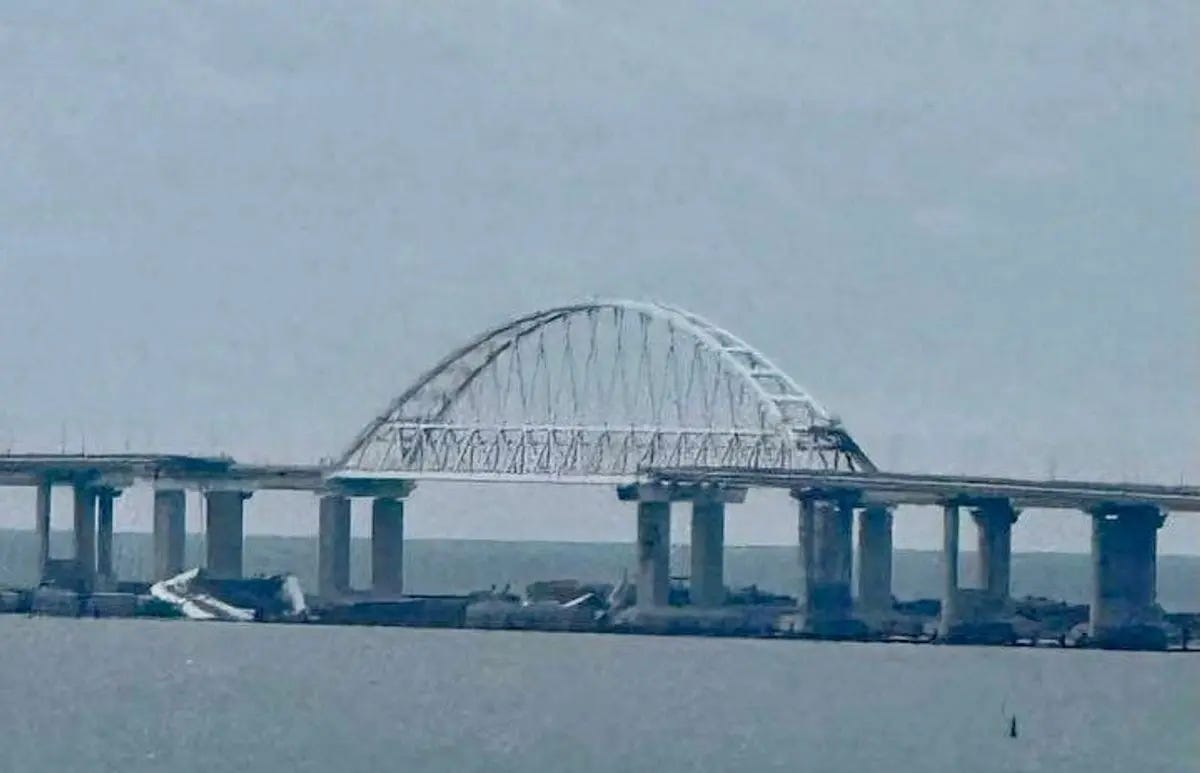
Overnight on November 16–17, 2026, the asymmetry of this managed theater delivered its inevitable physical receipt. Following two consecutive waves of strikes in less than 24 hours, a 745-foot-wide arch and highway span of the Kerch (Crimean) Bridge collapsed into the sea, severing road traffic, stranding thousands of vehicles, and blocking the navigable shipping channel between the Black Sea and the Sea of Azov.
Look at the ledger:
Ukraine’s 21 Dnieper bridges: Left standing for 1,728 days despite Russia possessing Kinzhal, Iskander-M, and Oreshnik systems engineered specifically to drop reinforced concrete bottlenecks.
Russia’s premier £3 billion flagship crossing: Breached twice in 24 hours and dropped into the strait, while six of Russia’s ten largest oil refineries sit unshielded—having lost 40% of primary refining capacity—and 700 structural-grade Antonov An-2 biplanes rot in storage boneyards.
Meanwhile, the radar horizon formula (D ≈ 4.12 × √h) continues to protect only one perimeter: the elevated Pantsir-SMD-E domes hoisted onto Moscow skyscrapers to shield the administrative elite while provincial Russia rations gasoline at 20 to 40 liters per car.
III. The Architecture of the Purge: Kudrinskaya Square vs. Fort McNair
In Parts V and VI, we established the rule of institutional pattern recognition: one dead general is a mistake; ten is a policy.
When we examined the August 2026 bombing of the Balzi Rossi restaurant at Kudrinskaya Square—which struck a birthday banquet for Aerospace Forces Commander-in-Chief Col. Gen. Aleksandr Chaiko and a concentrated gathering of General Staff officers—the physical topography of the site stripped away the last shred of the “security lapse” narrative.
A visual and spatial audit of 2 Bol’shoy Konyushkovskiy Pereulok and 4–8 Barrikadnaya Ulitsa confirms that the Stalinist skyscraper complex is a natural urban fortress:
The High Ground: The entire block sits atop a steep urban hill overlooking the surrounding street grid, forcing anyone approaching on foot to walk up an exposed incline.
The Two-Story Granite Podium: The restaurant and its outdoor terrace rest on an elevated red-granite retaining wall roughly two stories above street level, eliminating any direct sidewalk walk-up access.
The Narrow Stone Chokepoint: Pedestrian access to the upper terrace is funneled through a single, enclosed stone staircase flanked by heavy balustrades.
Securing that hilltop citadel for a room full of wartime VIP commanders required no army—merely two armed FSO or Rosgvardiya guards posted at the bottom of the stairs to intercept packages before they climbed the steps. Instead, all five state security layers (FSO, FSB Military Counterintelligence, Rosgvardiya, MVD, and the Safe City facial-recognition grid) stood down simultaneously. A courier walked up the hill, crossed the open plaza, and climbed the entire staircase unchallenged, stopped only by a private restaurant guard at the very top threshold next to the dining terrace.
Now compare that deliberate exposure in wartime Moscow to standard survival protocol in Washington, D.C. in November 2026:
The United States is not fighting a conventional war on its own soil. Yet, facing asymmetric intelligence threats, Washington immediately relocated senior civilian cabinet officials—including Secretary of State Marco Rubio, Defense Secretary Pete Hegseth, and Treasury Secretary Scott Bessent—out of open civilian neighborhoods and into fortified military compounds such as Fort McNair, behind armed perimeter checkpoints.
Russia has been at war for 1,728 days, with drones and bombs striking its own capital. Yet the Kremlin left its active General Staff planners and Aerospace Forces leadership living in ordinary civilian apartment blocks and dining on elevated public terraces without a single guard at the foot of the stairs.
You do not need a security clearance to read that contrast. When a state locks down a cemetery overnight to stop citizens from laying flowers on Yevgeny Prigozhin’s grave, yet leaves a hilltop granite fortress unguarded during a gathering of its top generals, the omission is the order. It was a preemptive decapitation of the only officer class inside Russia capable of mounting an insurrection from within and stopping the controlled demolition.
IV. The Final Receipt
From the silent telephone in Dresden in 1989 and the abandonment of the Lourdes SIGINT station in 2001, to the carried order that halted Russian forces at Crimea in 2014, to the offshore pipelines funding Western luxuries in London, Geneva, Paris, and the Bahamas while Russian conscripts bleed in the mud—the pattern is unbroken.
This was never a war fought to win. It is a managed extraction loop—Yeltsin 2.0 without the alcohol—engineered to hollow out Russia’s military, exhaust its economy, sever its strategic leverage, and condition a broken nation to accept a staged capitulation when the palace declares that the economy can endure no more.
Others may argue over the script read by the actors on state television. But this is what is written in the ledger book. China must see it too, and Xi surely recognizes Putin for what he really is. No wonder Power of Siberia 2 has still not been built: putting all of China’s eggs into the Russian basket is a suicide mission, and Xi is no fool.
A Note on Sovereignty:
The Dissenter is 100% free, uncompromised, and carries zero corporate ads or algorithmic sponsors. This archive is funded entirely by reader sovereignty.
And with this we have reached the end of this essay. I wish all of you a very nice day or afternoon wherever you are on our planet. See you soon