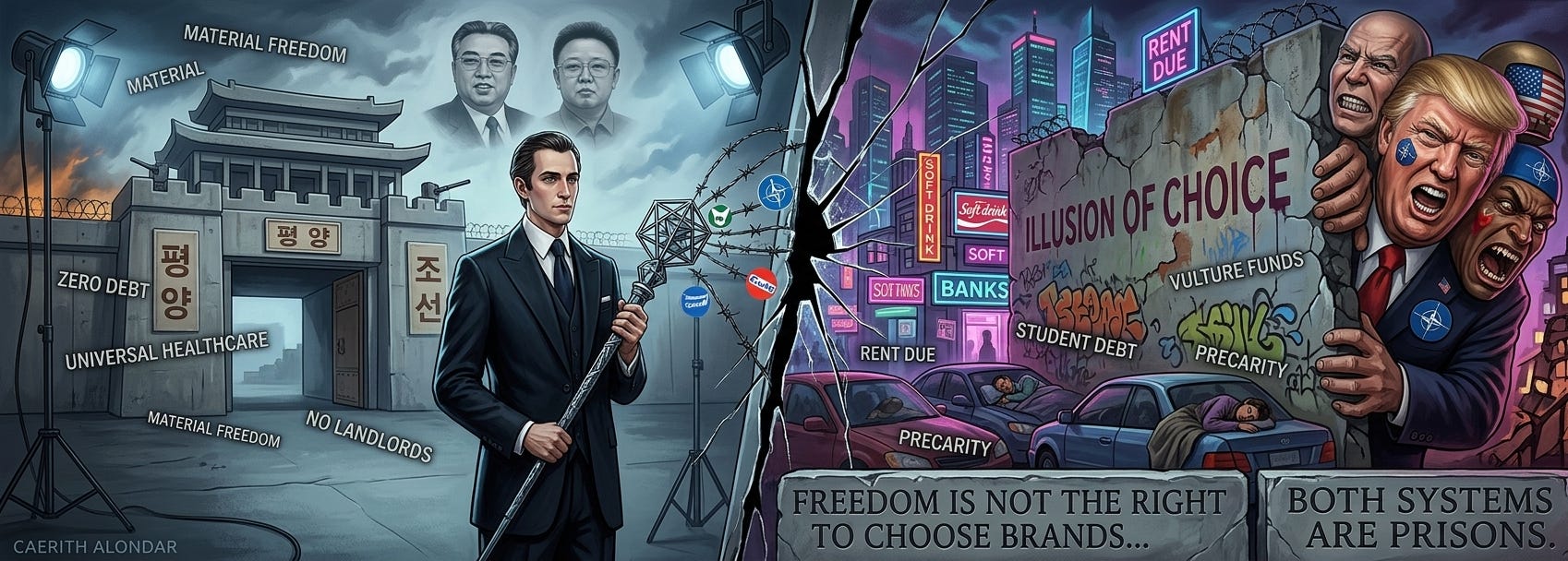
I. The Courier of the Absurd
There is a distinct vertigo that occurs when a descendant of the Spanish aristocracy—a Baron de Les and direct scion of a Carlist military lineage—sits beneath podcast studio lights in Madrid to explain, with monastic calm, why the dynastic succession of the Kim family is the highest realization of Marxist humanism.
For over three decades, Alejandro Cao de Benós has inhabited a geopolitical twilight zone. As the primary Western delegate for the Democratic People’s Republic of Korea (DPRK), his presence in European media is usually treated as a circus curiosity: a caricature to be paraded on commercial morning television for ratings before being dismissed as a lunatic.
Yet when one strips away the sneering sensationalism of corporate journalism and listens to the uninterrupted three-and-a-half-hour exposition of his worldview, something far more sinister emerges. The discourse of Cao de Benós is not the deranged ranting of an outsider; it is a meticulously constructed, terrifyingly coherent philosophical counter-mythology.
More importantly, it functions as a dark, unyielding mirror held directly to the decaying face of late-stage Western techno-capitalism.
II. The Semantic Inversion: Redefining the Prison
Cao de Benós begins with a maneuver of pure semantic dislocation: Corea del Norte no es una dictadura.
To the Western mind, trained on the dogmas of individualist consumer sovereignty, the claim sounds like dark comedy. How can a state with hereditary dynastic succession, state-mandated portaiture in every living room, zero independent press, and absolute border closure claim to be free?
Cao de Benós’ answer does not defend the system on Western terms; it detonates the premises of Western liberal vocabulary:
“What is freedom? Is freedom the right to choose the brand of soft drink you consume while you sleep in your car because you cannot afford rent? Is freedom the right to cast a ballot every four years between two factions funded by the same private banks, while childhood poverty surpasses twenty percent?”
Here lies the rhetorical engine of the DPRK’s survival strategy. It transposes the definition of liberty from political agency to material baseline.
In the calculus of Pyongyang, freedom is not the right to speak or migrate; it is the abolition of real estate speculation, the eradication of private landlords, the elimination of student debt, and the guarantee of a roof, rice, medicine, and burial at state expense. By contrasting this absolute material paternalism against the brutal precarity of the Western working class—where millions are one missed paycheck away from destitution—Cao de Benós forces the Western auditor into an uncomfortable realization: both systems are prisons; one merely decorates its walls with neon billboards and debt instruments, while the other coats them in concrete and ideological liturgy.
III. The Confucian Avatar: Feudal Socialism and the Cult of the Bloodline
Classical Marxism-Leninism was supposed to be a dialectical materialism—cold, scientific, and relentlessly hostile to feudal mysticism. Why, then, does the DPRK look like an ancient, hereditary Goryeo kingdom wrapped in an olive-drab military tunic?
Cao de Benós solves this paradox not by appealing to Marx, but by retreating into Confucian filial piety and Asian exceptionalism.
In his telling, the Kim family is not a monarchy; they are the paternal axis of an extended national family. He invokes Buddhist concepts of the avatar—a descent from Mount Paektu with double rainbows, an ontological entity tasked with preserving the spirit of the collective against external annihilation. He rationalizes hereditary governance as a matter of “tested moral pedigree” and cultural trust.
This is where the mask slips, revealing the deep syncretism of the DPRK: it is an ethno-nationalist, neo-Confucian theocracy masquerading as a workers’ paradise. The citizen does not obey out of brute terror alone, but through an engineered hyper-morality where individual deviance, refusal to work, or lack of state veneration brings existential shame upon one’s entire ancestral lineage.
Control in the DPRK is not merely maintained by the state’s internal security apparatus; it is crowd-sourced to the living room, where the portraits of Kim Il-sung and Kim Jong-il gaze down from the wall—symbols of a mandatory, eternal debt of existence that the citizen can never fully repay.
IV. The Material Wellbeing: What the Western Media Systematically Eclipses
100% Free and Debt-Free Housing: The state assigns homes directly to citizens without rent, mortgages, or property taxes, entirely eliminating real estate speculation, household bank debt, and private landlords.
Free Universal Healthcare: All medical care, surgeries, and treatments are fully public and cost-free, removing the threat of personal bankruptcy due to medical emergencies.
Comprehensive Public Education: Complete coverage from early schooling through university at state expense, allowing youth to graduate without student loan debt.
Full Employment and Higher Compensation for Manual Labor: Guaranteed 0% unemployment, with assigned jobs for every active citizen. High-risk or physically demanding roles (such as mining and agriculture) receive higher wages than administrative or medical positions to compensate for the physical strain.
Lifelong Basic Coverage: Guaranteed state allocation of essential foodstuffs (like rice) and fully funded burial services upon death, ensuring long-term family security.
Zero Direct Taxation: Personal income taxes are entirely abolished, with public infrastructure and social services funded directly through state-owned economic management.
Virtually Free Utilities & Mass Transit: Electricity, water, heating, and public transportation (such as the Pyongyang Metro and city buses) are heavily subsidized, costing citizens only a symbolic token fee.
Public Safety & Zero Street Crime: He emphasizes the absolute absence of violent street crime, illegal drug cartels, muggings, or gang activity, allowing children to walk home safely at any hour without parental anxiety.
State-Funded Childcare & Paid Maternity Leave: Mothers receive extended fully paid maternity leave alongside free nurseries and preschools attached to factories, farms, and universities, ensuring parents never face prohibitive childcare costs.
Subsidized Vacations & Cultural Access: Workers receive state-sponsored rest periods at mountain resorts, coastal sanatoriums, and hot springs, as well as free or low-cost entry to theaters, sports complexes, and cultural events.
Early Retirement & Pension Guarantees: Retirement age is set around 60 for men and 55 for women (earlier for heavy industrial workers), with lifetime state pensions, continued medical coverage, and housing security guaranteed post-retirement.
Social Cohesion & Reduced Mental Strain: He highlights the lack of commercial pressure, hyper-individualism, and economic-driven anxiety (such as fear of bankruptcy or eviction), claiming this fosters strong neighborhood networks (Inminban) and prevents social isolation.
The Paywall of Human Dignity:
When you are poor in the West, your choices are a banner, an illusion, not a reality
As the writer Anatole France famously observed, “The law, in its majestic equality, forbids rich and poor alike to sleep under bridges, to beg in the streets, and to steal their bread.” On paper, a person living in poverty in the West has the legal “choice” to start a corporation, buy a home, travel the world, or hire a legal team. But without the financial capital to exercise those rights, they exist only as theoretical permissions—a banner waving over a reality of strict limitation.
Poverty in a market-driven society enforces its own quiet, relentless form of coercion. A state apparatus doesn’t need to post a guard outside your door to restrict your movement when the cost of rent, transit, and food does it for them. The threat of destitution acts as an invisible enforcer, narrowing human existence down to sheer daily survival. When basic necessities like shelter and healthcare are treated as market commodities rather than fundamental human infrastructure, freedom is effectively paywalled.
This is precisely why radical critiques hit with such force: they expose the hypocrisy of celebrating “individual liberty” in a system where millions are left entirely unprotected by the market. The tragic friction of modern geopolitics is that people are constantly asked to choose between a system that offers abstract rights without guaranteeing survival and systems that promise survival by stripping away individual agency. Recognizing that market freedom is hollow without a material baseline isn’t an endorsement of state authoritarianism—it is a demand for a world where basic human dignity isn’t treated as a luxury item.
V. The Logic of the Siege: Why Pyongyang Built the Bomb
To understand why the DPRK has not collapsed—and why men like Cao de Benós defend it with fanatic zeal—one must reckon with the foundational trauma of American imperial architecture.
Western commentators consistently frame the Korean conflict as an unprovoked aggression by a rogue state. Cao de Benós correctly reminds his audience of the historical baseline: the Korean War never ended. The 1953 armistice was signed between the DPRK and the United States, leaving South Korea as an operational military garrison hosting thirty thousand foreign troops and nuclear-capable strike platforms on Pyongyang’s doorstep.
In a world that watched the televised evisceration of Baghdad and the lynching of Gaddafi after Libya surrendered its nuclear program, Pyongyang’s Songun (Military-First) doctrine is not madness—it is brutal, rational survivalism.
“You attack a bully by showing your teeth. Donald Trump tore through Latin America and the Middle East, but he walked across the DMZ to shake hands with Kim Jong-un because our missiles reach Washington.”
The tragic irony of the Korean Peninsula is that the American empire created the very monster it decries. By maintaining a seven-decade strangulation of sanctions, naval blockades, and simulated invasions, the West gave the DPRK regime the ultimate ideological gift: an eternal, undeniable external enemy that justifies internal scarcity, militarization, and total surveillance in the name of national survival.
VI. The Mirror: A Symptom of Systemic Decay
The most revealing moment of Cao de Benós’ testimony is not what he says about North Korea, but what he reveals about the West.
Here is a man who, under the banner of Western “rule of law,” has had his passport seized for ten years by Spanish courts without a trial date while being hunted by the FBI via Interpol for organizing a cryptocurrency conference in Pyongyang. He moves through European institutions, highlighting their blatant hypocrisies: the revolving doors between judges and police chiefs, the corporate censorship of dissenting academics, and the commodification of human life from healthcare to housing.
Cao de Benós is not an effective propagandist; he is documenting, not because his depiction of North Korea is flawless—it is not an idealized, heavily curated defense of a survival state reality—but because the West has forfeited its moral standing to refute him.
When a society reduces human existence to a brutal algorithmic competition for survival, where housing is hoarded by vulture funds, where pharmaceuticals are priced for maximum extraction, and where imperial foreign policy operates through drone strikes and economic starvation, the state mythologies of the DPRK cease to sound entirely alien.
They become a dark, distorted echo of the West’s own failure: a reminder that when civilization abandons the soul of humanity, the only choices left on the global menu are the neon jungle of techno-feudalism or the concrete walls of the hermit state.