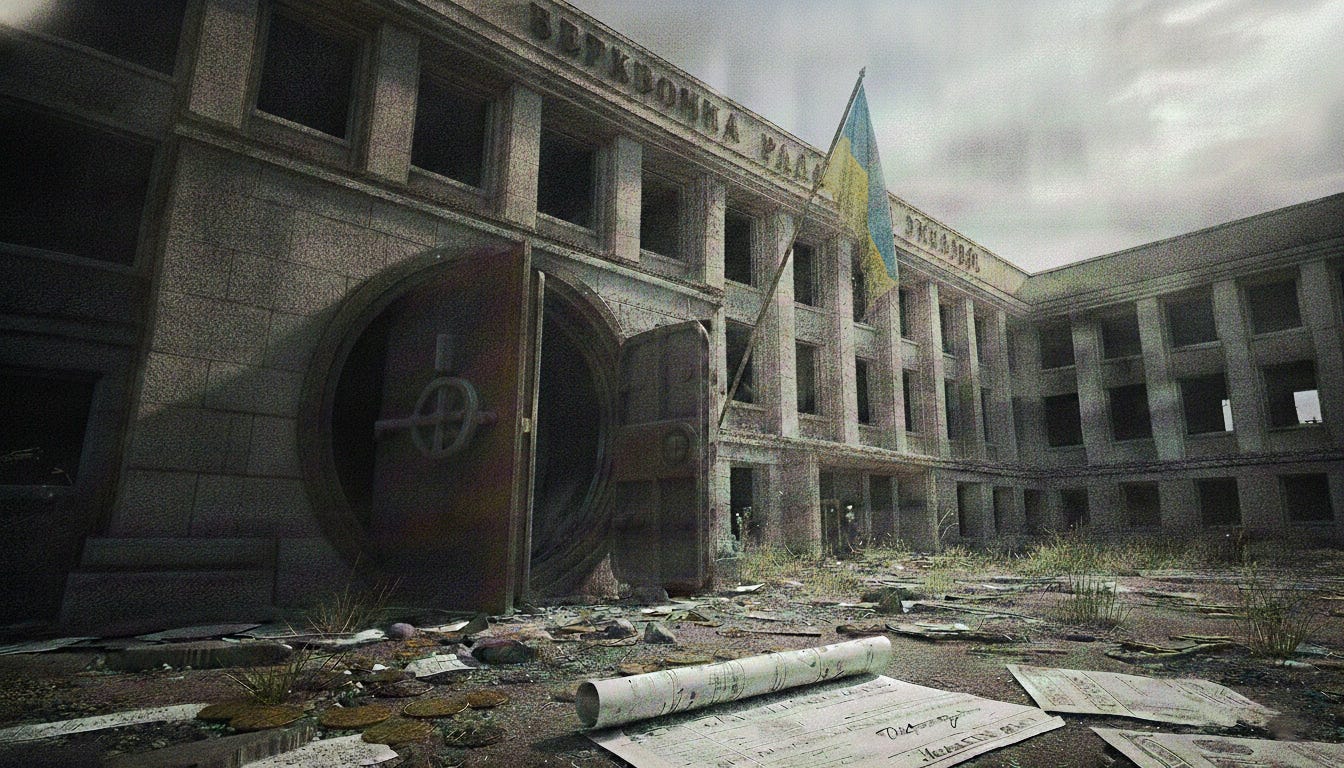
An analysis of the 2014 Ukraine crisis, the Nuland-Pyatt leak, and how the strategic failure to secure Kyiv established the architecture for a perpetual, managed geopolitical conflict.
In early 2014, Viktor Yanukovych stood as the absolute personification of the post-Soviet kleptocracy. He was a leader who did not run a state but rather presided over its systematic looting, converting the presidency of Ukraine into a highly profitable family business.
Under his clan’s oversight, the Ukrainian state was not built; it was hollowed out from within, leaving a fragile shell of a nation that was economically bankrupt, politically fractured, and militarily paralyzed long before the first protestor ever stepped onto the Maidan.
To understand the sheer magnitude of the strategic opportunity Russia possessed in the spring of 2014, one must first look directly at the unvarnished ledger of Ukraine’s economic and political collapse.
Economically, the country was a hollow vault. On February 27, 2014, as the newly formed post-Maidan coalition took power in Kyiv, Prime Minister Arseniy Yatsenyuk stood before parliament to deliver a devastating financial autopsy of the state. The numbers were not merely challenging; they represented a complete sovereign death:
The Embezzled Wealth: The Yanukovych-Azarov administration had funnelled an estimated $70 billion out of the country into offshore zones.
The Disappeared Capital: Over $20 billion in gold and currency reserves had been embezzled.
The Vanished Loans: $37 billion in foreign loans had completely vanished.
The Empty Vault: In the central state treasury of a nation of 45 million people, the regime had left behind a pathetic, historic balance of exactly 4.3 million hryvnia—a sum equivalent to roughly $430,000 USD.
But Yatsenyuk’s sudden ascension to the pulpit was no organic accident of history. The empty treasury was inherited by a scriptwriter already waiting in the wings. Weeks earlier, on February 7, 2014, the BBC published a fully transcripted audio leak of an intercepted phone conversation between U.S. Assistant Secretary of State Victoria Nuland and U.S. Ambassador Geoffrey Pyatt.
In the tape, Washington’s architects are caught hand-picking the post-coup cabinet while the street fighting was still underway. Nuland’s voice cuts through the illusion of Ukrainian self-determination with raw precision: “I think Yats is the guy who’s got the economic experience.”
When Pyatt raises concerns about how European diplomats might react to the U.S. micro-managing the transition, Nuland dismisses the entire European continent with a single, blunt directive: “Fuck the EU.”
When the dust settled on February 27, “Yats” was exactly who sat in the prime minister’s chair. Ukraine was not just bankrupt; it was functionally repossessed and politically pre-selected by Washington diplomats who openly held their own allies in contempt. The state was a country on the absolute brink of default, saddled with a $75 billion national debt, unable to pay social benefits, maintain subsidies, or keep its basic financial system functioning without emergency international intervention.
Politically, the Ukrainian state was a vacant house. The oligarchic clans that actually ran the country’s provinces were highly pragmatic; their loyalty was not ideological but financial. The moment the violence in Kyiv escalated, they abandoned Yanukovych, prioritizing their own Western assets and businesses over a collapsing president.
Chief among these opportunists was Petro Poroshenko—the multi-billionaire confectionery tycoon known universally as the “Chocolate King.” Poroshenko did not just watch the transition; he financed it. Using his privately owned television network, 5 Kanal, to broadcast around-the-clock pro-Maidan messaging, he weaponized public anger to clear his own path to power. By May 2014, the “anti-corruption revolution” achieved its ultimate contradiction: it crowned the Chocolate King as the new president of Ukraine. The regime change was complete; the old kleptocracy was simply rebranded under a Western-compliant, billionaire asset.
The military institutions of the state had fared even worse. Decades of chronic underfunding, corruption, and deliberate neglect had reduced the Ukrainian armed forces to a state of total paralysis.
Out of a nominal force of over 100,000 soldiers, the country possessed only 6,000 combat-ready troops in early 2014. The military command was completely paralyzed, with officers in the field entirely unsure of who represented the legitimate sovereign or whether they should follow orders from the unconstitutional transition government in Kyiv.
It was into this vacuum of power, bankruptcy, and military paralysis that the ultimate strategic key was forged.
After fleeing the capital to seek asylum in Russia, Viktor Yanukovych sat in exile and signed his name to a piece of paper on March 1, 2014. It was a formal, official request from the constitutionally recognized president of Ukraine, appealing directly to the president of the Russian Federation to use the armed forces of Russia to restore law and order, peace, and stability and to protect the population of Ukraine.
Two days later, on March 3, Russian Ambassador Vitaly Churkin held this paper up before the United Nations Security Council.
This document was the golden key. Because Ukraine was politically fractured, economically bankrupt, and possessed only 6,000 combat-ready troops, a swift, targeted stabilization mission directly into Kyiv under the cover of this legal invitation would have faced virtually zero conventional combat or military resistance.
Securing the capital would have automatically secured Crimea, frozen the political transition, and preserved Russia’s strategic depth permanently without a single shot being fired in a major war.
Yet, the sovereign did not turn the key.
Instead, the Kremlin chose the path of comfortable half-measures. They used Yanukovych’s paper as a quick legal shield to pull off a cheap, popular land grab in Crimea while abandoning the rest of Ukraine to the USA and CIA takeover. They left the brain of the Ukrainian state intact, a gift to NATO, allowing the new pro-Western government to spend the next eight years consolidating power, unifying its national identity, and rebuilding its military into a highly capable, WEST-aligned bulwark.
The Lourdes site in Cuba
During the Cold War, the Soviet Union constructed its largest foreign signals intelligence installation on Cuban soil, roughly fifteen kilometers south of Havana. Officially operational between 1964 and 1967, the Lourdes SIGINT station was the Kremlin’s ear pressed against the American jugular — intercepting U.S. diplomatic, military, and satellite communications from a position so close to Florida that it sat directly within the footprint of major American communication satellites.
For nearly four decades, Lourdes was not a luxury. It was a strategic organ. And in 2001, Vladimir Putin cut it out.
The official narrative insists the closure was a pragmatic decision driven by high operational costs and the diplomatic pressures of a new era, a convenient explanation for a state that was, at the time, still financially crippled and eager for Western approval.
But no sovereign power permanently blinds its own intelligence apparatus to save money, and no leader who genuinely intended to restore Russia’s strategic independence would hand Washington the single greatest gift of the post-Cold War era: the certainty that no one was listening.
Putin’s Early Desires to “Fit In” with the West
Lourdes was not an isolated concession. During his first presidential term (2000–2004), Putin pursued a distinctly pro-Western foreign policy, seeking not to challenge the American-led order but to be admitted into it. After September 11, he was the first foreign leader to call George W. Bush, offering full solidarity and intelligence sharing. He shuttered the naval base at Cam Ranh Bay alongside Lourdes, packaging both as proof that Russia was a “normal” power, done with Cold War rivalries, and ready to sit at the adults’ table. The public message was partnership. The pattern, read as a whole, was submission. And submission, in the grammar of intelligence, is what an asset does when the handler’s instructions are indistinguishable from his own ambitions.
The Manchurian Candidate
The Dresden Mystery (1985–1990): Putin’s five years as a mid-level KGB officer in East Germany remain, by his own design, a sealed room. Official biographies describe a mundane bureaucratic posting, filing reports, cultivating low-level contacts, and watching the Berlin Wall from the wrong side. Yet counter-intelligence history is littered with officers stationed in precisely this kind of environment: vulnerable, crumbling satellite states where Western services hunted for assets who could outlive the system they served. The Soviet Union was already dying. The question was never whether recruitment attempts were made. The question is whether one of them succeeded.
The answer will never come from a declassified file. It will come from the pattern. And the pattern begins the moment the man in the sealed room starts making decisions that no sovereign would make.
The “Addresses” of Compliance
Nowhere is the theatrical nature of this conflict more nakedly exposed than in the current reality of the drone war. Right now, Russia is reaping the bitter harvest of a thousand hollow “red lines” crossed by NATO. In a single coordinated offensive, Ukrainian forces launched a record 992 long-range strike drones into the Russian interior in one 24-hour period, targeting critical infrastructure, paralysing airspace, and striking the Moscow oil refinery directly.
Then the Kremlin did something extraordinary. The Russian Defence Ministry published a list. Not a vague strategic assessment, not a classified briefing leaked to journalists a public document containing the specific names and physical street addresses of companies across eleven European countries, in London and near Manchester, Munich, Prague, and Riga, allegedly assembling strike drones for strikes on Russian territory. The ministry’s instruction to the European public was blunt: “We know the addresses.”
When pressed on whether Russia intended to strike those specific locations, Kremlin spokesperson Dmitry Peskov did not deny it. He confirmed, “The direct involvement of these countries in the conflict is growing; the details are all set out in the Defense Ministry’s statement.” Former President Medvedev made the threat explicit, posting that the published list must be taken “literally” as a directory of “potential targets for the Russian armed forces,” signing off with, “Sleep well, European partners!”
The sovereign himself declared, “We know where the drones are made; we have the addresses.”
And yet, absolutely nothing happens.
The standard objection writes itself: those addresses sit on NATO soil, and striking Munich or London means Article 5, means annihilation, and means the end of everything. But this is precisely the theatrical architecture the asset was designed to maintain.
The addresses were published not as a prelude to action but as a performance of impotence, a sovereign who names his enemy’s factories, threatens them to their faces, and then watches the next wave of drones assemble on schedule. Caution does not require a handler. A handler is required to explain the performance of the threat, followed by the certainty of inaction.
In any genuine sovereign conflict, this sequence—publish the addresses, threaten the factories, then do nothing while the drones keep coming—would be unthinkable.
Here, it is policy. This is the pattern’s loudest confession: the vertical is not suffering from a lack of intelligence but from the constraints of a role. The asset cannot strike those addresses because doing so would dismantle the very theater he was hired to maintain. The “30-year war” requires that the enemy’s production lines remain safe, ensuring that the slow-burning extraction loop continues to bleed Russia’s industrial sovereignty from the inside out.
In conclusion
This was the original sin of the managed decline. The “30-year war” lie of 2026 is the direct child of the cowardice of 2014 and the earlier capture of a Manchurian Candidate. The regime is burning Russia’s youth, its economic reserves, and its industrial sovereignty today, hoping that the projection of infinite time will postpone the day of reckoning for the original strategic betrayal they committed twelve years ago.
As the preceding Part I to Part III of this ledger have documented in operational detail from the systematic avoidance of every classical principle of decisive warfare to the deliberate failure to isolate the theater, the hypothesis of mere incompetence has been exhaustively eliminated.
By eliminating stupidity as a variable which, given the survival and consolidation of the power vertical in Russia under Putin, is a valid analytical deduction you arrive at the binary conclusion that forms the bedrock of this five-part ledger: either the leadership is fundamentally incapable, or they are serving interests that are not those of the Russian state but those of NATO.
When you look past the theatrical public rhetoric and track the raw material outcomes on the ground, the true endgame reveals itself. This is not a war of expansion; it is a controlled demolition. Putin is operating not as a sovereign defender, but as the ultimate asset of a managed decline—sacrificing Russia’s youth, draining its financial autonomy to Beijing, and burning through its industrial reserves to achieve a singular Western objective.
The script does not end with a Russian victory. It ends with a wasted demographic hollow, systematically broken down to force the country back into the defenseless vulnerability of the Yeltsin years—plundered, partitionable, and reintegrated into a Western financial system to artificially prolong the fading life of a global empire.
The hegemony is in an almost terminal phase, caught in the seven-stage sequence of imperial collapse first mapped by Sir John Glubb — a British officer who watched his own empire traverse every one of them within his lifetime — and observed in every great power from Rome to Britain. The pattern has never, in recorded history, reversed itself. The Pattern Never Fails
Stage 1 — Dominance
Stage 2 — Overextension
Stage 3 — Overspending
Stage 4 — Currency Debasement
Stage 5 — Inflation
Stage 6 — Loss of Confidence
Stage 7 — Collapse
The 2014–2026 managed meat-grinder is not a sign of Western strength, but a desperate, mathematical extraction loop designed to bleed its rivals, consolidate domestic capital, and delay the final, inevitable transition into Stage 7.
If in Russia, a general seizes command, orchestrates the necessary removal of Putin, he will not repeat the operational blindness of 2022. The failure to secure Kyiv twice, first by political invitation in 2014, then by military force in 2022, was not a lack of hardware; it was a catastrophic failure of basic operational art.
The columns advanced unprepared. Kyiv’s defenses were never suppressed. The head of state remained intact, and his communications networks operated unimpeded. They even air-dropped elite paratroopers into a nearby airport only to have them neutralized for zero strategic gain, an absurdity later defended by apologists as a mere “distraction maneuver” for the southern front. That is not strategy; it is a hollow excuse that only underscores the deliberate incompetence of the command.
A sovereign commander does not send armor into a Capital City while leaving the enemy’s brain and nervous system fully functional. He would first unleash the immense missile and drone ordnance the army possesses to decapitate that exact command structure. In one to three days of concentrated, overwhelming strikes, the leadership, the communications hubs, and the logistical nodes would be vaporized.
Europe and the UK would be instantly paralyzed in their war efforts. Who will they send money, parts, drones, or military equipment to if all their contacts are dead? From there, it is merely a matter of sweeping the battlefield, occupying Kyiv, liberating Ukraine from NATO, and absorbing the territory as a province once again.
Muerto el perro, se acaba la rabia. (When the dog is dead, the rabies ends.)