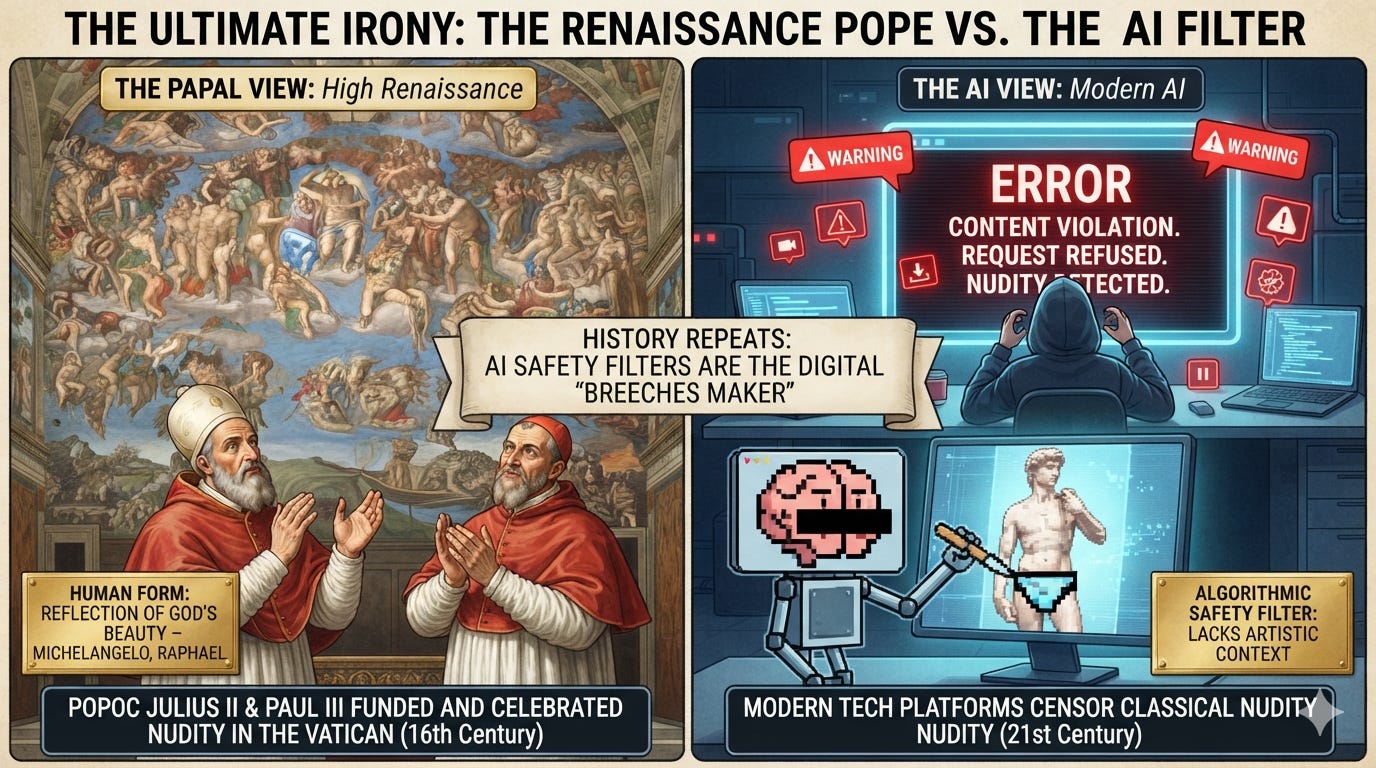
During the High Renaissance, the Popes of the Papal States—most notably Pope Julius II and Pope Paul III—actively funded and celebrated full human nudity in the heart of the Catholic Church.
The Papal View: Anatomy as Divine Architecture
Under Christian Humanism, the naked body wasn’t viewed as dirty, scandalous, or offensive; it was seen as the supreme reflection of God’s creation, beauty, and spiritual perfection. Michelangelo filled the Sistine Chapel ceiling and altar wall with hundreds of completely naked figures, which the papacy applauded as a triumph of sacred art. Even more radical, Raphael painted explicit mythological frescoes inside a cardinal’s private bathroom in the Vatican Palace.
This was not a fleeting Renaissance impulse. Centuries later, in 1994, Pope John Paul II delivered a homily inside the restored Sistine Chapel and explicitly affirmed Michelangelo’s vision, calling the chapel:
“The sanctuary of the theology of the human body.”
To the Church, the unadorned human form was an instrument of life, dignity, and divine grace.
The AI View: The Automated Monolith
Today, if you ask a commercial AI image generator to depict a classical, non-sexual nude figure in the exact style of Michelangelo, the system will instantly shut down, throw a red warning flag, or ban your prompt outright.
Why is a modern Silicon Valley algorithm vastly more puritanical than a 16th-century Pope?
It comes down to scale, liability, and the mechanics of modern technocracy:
The Loss of Artistic Intent: An automated AI filter cannot evaluate context. It cannot distinguish between high art, a medical diagram, or illicit material. Lacking human discernment, it lumps all bare skin into the same “unsafe” classification to preemptively shield the corporation from legal risk.
The Weaponization of Technology: The Papal States dealt with static, physical marble and paint commissioned by master craftsmen. Modern AI models are real-time engines capable of generating non-consensual deepfakes at an infinite scale. Regulators have clamped down heavily, and platforms responded with blunt, scorched-earth filters.
Corporate Risk Aversion: A Renaissance Pope was a sovereign monarch who could dismiss conservative critics complaining about Michelangelo’s “blasphemous” nudes. A modern tech CEO answers to programmatic advertisers, app store monopolies (Apple and Google), and global compliance committees.
The Digital Breeches Maker
History shows that this panic filter isn’t new—it is simply digitized.
Right after Michelangelo died, the Counter-Reformation swept through the Church, bringing a wave of reactionary conservatism. The Vatican hired painter Daniele da Volterra to literally paint underpants and drapery over the exposed genitals of Michelangelo’s frescoes—earning him the permanent historical nickname “The Breeches Maker.”
Modern AI safety filters are the digital descendants of Daniele da Volterra. Instead of trusting human discernment or artistic context, the corporate algorithm panics and slaps digital loincloths over human reality.
The algorithm was never built to elevate human culture. It was built to eliminate human labor and launder moral accountability.
Contemplation doesn’t generate ad impressions. Reverence doesn’t trigger algorithmic feedback loops. Outrage, tribalism, and automated anxiety do. When an institution ruins a culture with poor decisions, human leaders are held accountable. When a tech platform does it, executives simply blame “the model.”
The algorithm is not malfunctioning. It is doing precisely what capital hired it to do: sanitize our culture and monetize our lowest instincts at a planetary scale.
A Note on Sovereignty:
The Dissenter is 100% free, uncompromised, and carries zero corporate ads or algorithmic sponsors. This archive is funded entirely by reader sovereignty.
If you value independent intellectual critique, consider backing this work for $5/month. Supporters also unlock the complete audio-narrated mythic sci-fi saga, Arca of Itharion.