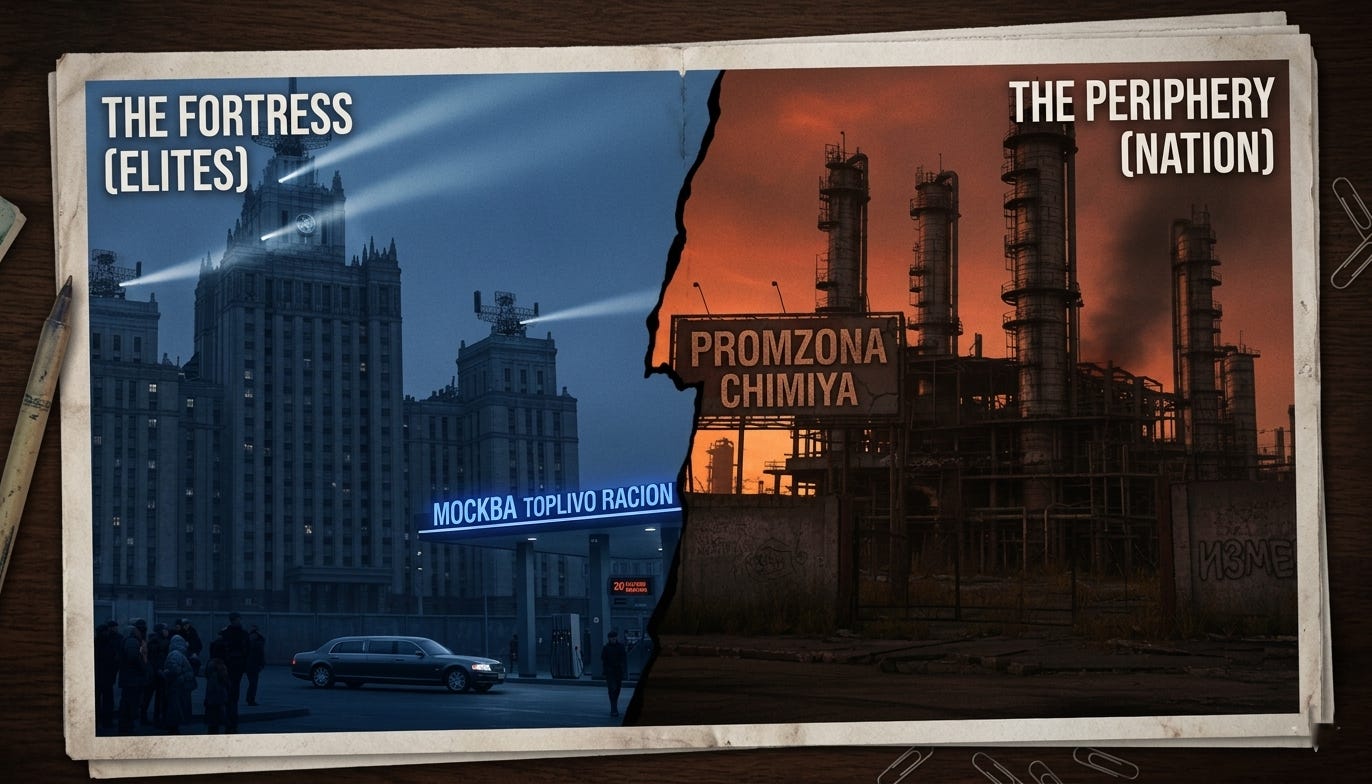
Managed decline is a strategic doctrine where a state deliberately sacrifices its own civilian infrastructure and economic stability to sustain a perpetual conflict that preserves elite power.
The current trajectory of the Russian state is defined by a jarring, intentional contradiction. At the 2026 St. Petersburg International Economic Forum (SPIEF), Andrey Bezrukov, an influential advisor within the Kremlin’s inner circle, openly declared that Russia must prepare for a state of war lasting “a couple of decades.” This is not a forecast of military necessity but a demand for the permanent structural transformation of the nation.
Yet, while the state demands that its citizens resign themselves to a generation of conflict, the infrastructure upon which those citizens rely is crumbling. In major urban centers like Moscow and St. Petersburg, fuel rationing has become a mundane fact of life, marking a visceral disconnect between the elite’s “30-year war” rhetoric and the reality of a nation being hollowed out.
The regime’s strategic narrative is further exposed by its selective approach to the conflict’s “targets.” Recently, the head of the State Duma’s defense committee, Andrei Kartapolov, dismissed the idea of targeting the Ukrainian presidential office or parliament, calling them irrelevant “empty places.”
This rhetoric—minimizing the war’s objective while simultaneously extending its timeline—reveals the core of the “Architecture of Managed Decline.” By explicitly stating that the enemy’s political leadership is not a target, the Kremlin signals that the goal is not to win the war but to sustain it.
Nowhere is this strategy of deliberate deferral more mathematically exposed than in the calculated preservation of the Dnieper River bridges. For over 1,500 days of high-intensity conflict, the Kremlin has left the 21 primary rail and road crossings north of Dnipro city entirely intact, allowing a continuous stream of heavy Western armor to roll unimpeded straight to the frontline to slaughter Russian infantry.
This is not an operational limitation; it is an active omission. Russia possesses an extensive arsenal of Kh-47M2 Kinzhal hypersonics, Iskander-M ballistic systems, and the Mach 10 Oreshnik IRBM—platforms explicitly engineered with terminal velocities and vertical penetration profiles capable of bypassing any air defense grid to drop these concrete structures.
By opting to scatter these precision assets across empty frontline treelines rather than concentrating a volume of 20 to 50 heavy payloads to cleanly collapse these 7-to-25-meter-wide bottlenecks, the high command has constructed a permanent, artificial logistical sanctuary for the adversary.
This “acolyte strategy” functions as a mechanism of delegated accountability. When figures like Bezrukov articulate the necessity of a 20-to-30-year conflict, they act as trial balloons for a leadership that prefers to remain uncommitted.
If the state’s foundation eventually gives way—if the economy collapses under the weight of perpetual militarization—the regime has its scapegoats ready. These acolytes are the architects of a facade, designed to convince the public that the hardship is a “holy” existential requirement, while the true strategic decisions are made behind a curtain of calculated indifference.
The most damning evidence of this betrayal is the regime’s selective deployment of national protection. The “rooftop defense” of Moscow, where advanced air defense systems were hoisted onto administrative buildings to protect the elite, contrasts sharply with the systematic neglect of industrial refineries across the country.
The state clearly possesses the technical capability to defend its critical infrastructure; it simply chooses to prioritize the immediate physical security of the ruling hierarchy over the arteries that power the nation’s daily life. This is not the incompetence of a struggling state; it is a policy of structural sabotage.
As in Part II: The mathematical exactitude of this selective protection is governed by the laws of radar geometry. By hoisting advanced point-defense modules onto 70-meter-high Moscow skyscrapers, the state effectively weaponized the radio horizon formula
(D ≈ 4.12 × √h) to clear urban ground clutter, expanding their low-altitude tracking canopy to a crisp 24-kilometer kinetic intercept boundary.
This proves with absolute certainty that the high command fully masters the physics of low-altitude drone interception. Therefore, the decision to deny similar elevated tracking frames and mobile point-defense arrays to the nation’s primary petrochemical hubs is a deliberate act of sacrificial zoning. The state did not fail to protect the country’s industrial heartland; it intentionally isolated it.
The resulting fuel crisis—where citizens are restricted to 20 or 40 liters of gasoline—is the inevitable byproduct of this choice. As strikes continue to degrade refineries that cannot be repaired without Western technology, the state is forced to choose: fuel the war machine or fuel the civilian economy.
By prioritizing the former while attempting to mask the systemic nature of the shortages with “artificial panic” narratives, the leadership is effectively burning the nation’s foundations to keep the lights on in the palace.
The hard economic ledgers of mid-2026 expose the final cost of this betrayal. While regular citizens face fuel limits due to a devastating 40% loss of primary refining capacity, the regime has flooded global markets with a record-breaking 2.8 million barrels of unrefined raw crude per day, trading long-term industrial sovereignty for discounted short-term cash flow to feed a ballooning 6-trillion-ruble federal budget deficit.
The standard bureaucratic excuse of resource scarcity is thoroughly demolished by manufacturing data: Russia’s factories are currently churning out between 3,000 to 5,000 long-range strike drones and jet-powered hybrids per month.
Enforcing a total land blockade on the seven international highways and sixty regional corridors converging into Kyiv is a solved logistical equation when backed by an infinite robotic production line. Yet, instead of focusing a continuous daily salvo to paralyze the enemy’s administrative and logistical grids, the high command chooses to disperse thousands of long-range payloads into random, non-strategic fields. This strips away the last illusion of military incompetence. It is premeditated, institutional sabotage
Ultimately, the term “traitor” is often used to describe those who work against the interests of their country. If the primary duty of a state is the protection and sustenance of its people, then the architects of this “managed decline” are presiding over the ultimate betrayal.
By sacrificing the long-term structural viability of the Russian Federation to sustain a conflict that serves only the interests of the existing hierarchy, the regime has turned the Russian state into a mechanism for its own self-destruction.
The “30-year war” is not a strategy for victory; it is a roadmap for a controlled collapse, orchestrated by those who would rather rule over the ruins than forfeit their grasp on power.
Enjoyed this deep-dive?
I also write mythic, high-concept science fiction. Read the first 4 chapters of my finished novels entirely for free:
👉 Start Reading Book 1: Arca of Itharion