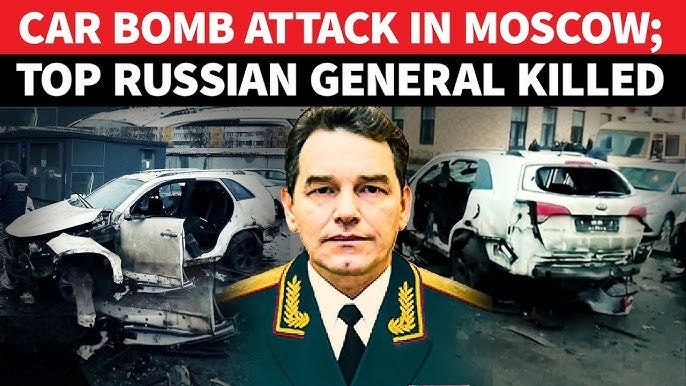
The man pictured in the image was Lieutenant General Fanil.
The systematic assassination of Russian generals without adequate security details represents a deliberate internal purge designed to remove military leadership capable of challenging the architecture of a managed geopolitical decline.
In Parts I through IV, we traced the architecture of betrayal. We followed the money, the tactical sabotage, the artificial war, and the original sin of 2014. We built a ledger of treason. But ledgers are abstract. Theories are cheap. Proof is paid for in blood.
You need to read: PRIGOZHIN: A HERO, A SAINT, OR A TRAITOR. 🕯️🕊️
complete. To fully understand this essay.
For weeks, we have analyzed the war through the lens of a failing military machine. We categorized the loss of high-ranking generals—car bombs in Moscow, IEDs in the rear, and targeted assassinations—as security failures. We looked for the incompetence, the breach in protocol, and the lack of an NCO corps.
We were not wrong. But we were not looking closely enough... Let’s take a look at the dead Russian generals...
One general killed is a failure of security. Two are in crisis. But when the list grows, when the methods are consistent, and when the targets are systematically removed, it ceases to be a security lapse. It becomes policy.
We must reconcile this with the glaring asymmetry that defines this conflict: the political leadership is afforded total, multi-layered protection, creating a fortress around those who hold the power. Yet, the military commanders—the men who command the front lines—are left exposed, mobile, and vulnerable.
This is not an oversight. It is a selection process.
When you leave your military leadership unprotected in a theater of war, you are not protecting your commanders; you are disposing of them. These “terrorist” attacks provide the perfect, convenient narrative: an external enemy is blamed, the investigation is kept behind closed doors, and the inconvenient voices who might have the authority or the conscience to stop the “Managed Decline” are removed from the board.
The “terrorist” label is the perfect administrative cover for a systematic liquidation. It allows the regime to maintain its narrative of a “war against an enemy” while it conducts a war against its own elements.
The generals are not casualties of war; they are the debris of a system that is consuming itself. We are not watching a military struggle for territory. We are watching a deliberate, top-down hollowing of the state.
The war does not end because it was never designed to end. It ends only when the machine has finished consuming what it needed to consume.
The “Liquidation” Count (Late 2024–2026)
This is distinct from frontline combat deaths; these are hits that occurred far from the front, often in Moscow or near-Moscow suburbs, using methods (scooter bombs and IEDs) that are signature tools of a domestic purge, not a front-line military engagement.
Lt. Gen. Igor Kirillov (Dec 2024): Killed by a scooter-mounted explosive device in Moscow.
Lt. Gen. Yaroslav Moskalik (April 2025): Killed by a car bomb in Balashikha.
Maj. Gen. Alexey Komkov (July 2025): Killed by a car bomb in Central Moscow.
Lt. Gen. Fanil Sarvarov (Dec 2025): Killed by a car bomb on Yasenevaya Street in Moscow.
Lt. Gen. Vladimir Alekseyev (Feb 2026): Shot in a “residential building” in Moscow (hospitalized).
Captain Valery Trankovsky (November 2024): A high-ranking Russian naval captain and chief of staff of the 41st missile ship brigade. He was killed by a remote-controlled car bomb that detonated beneath his vehicle while he was driving through the streets of Sevastopol, Crimea. Just like the Moscow generals, his daily movements were perfectly tracked.
Commander Stanislav Rzhitsky (July 2023): A submarine commander in the Black Sea Fleet and a mobilization officer. He was systematically ambushed and shot dead while on his predictable morning jog through a public park in the southern city of Krasnodar. He was completely unprotected by state services.
Political Officer Zakhar Prilepin (May 2023): A prominent pro-Kremlin nationalist writer, ideological figurehead, and ranking National Guard (Rosgvardiya) combat officer. He was targeted deep within the Russian interior—the Nizhny Novgorod region—when an anti-tank mine split his vehicle in two, killing his aide and leaving him severely mutilated. Operating completely outside the state’s security dome, his rural itinerary was exposed to the open air.
Propaganda Asset Illia Kyva (December 2023): A high-profile defected lawmaker turned state television psychological warfare instrument. He was hunted down and executed by gunfire in a snow-covered park area outside a luxury hotel complex in Suponevo, a quiet suburb just west of Moscow. Despite his hyper-visible role as a mouthpiece for the regime’s annexation rhetoric, he was left to walk a predictable public routine with zero state protection details.
Maj. Gen. Sergey Goryachev (June 2023): Chief of Staff of the 35th Combined Arms Army. Though operating in the wider theater, his elimination represents a digital abandonment. His command headquarters was completely stripped of the active electronic warfare and signal-jamming arrays that legally secure top-tier FSO perimeters, allowing his exact coordinates to be leaked and pinpointed with absolute finality.
THEN YOU ASK YOURSELF
Why did these men have no security traveling with them if the government was supposedly aware they were targets of Ukrainian terrorist attacks? After all, they were super VIPs of the Russian army.
Why did they not have an armored car with a chauffeur? Why not an escort of two or three armed soldiers or FSB agents?
Why were the places they visited not scrutinized before they entered, with a secure car idling outside waiting for them, no matter how long it took?
Why were they not ordered to live within the fortified perimeter of a military installation for the duration of the war?
Did the FSB possess actionable intelligence on these threats prior to the first attack and simply fail to act?
Logical safety measures were not merely ignored; they were bypassed. This level of casual exposure is too deliberate to be a mistake.
Then, we have to look at who they were.
The Missing Ledger: Who They Were
We do not have a neatly filed public list of these men. We have a trail of breadcrumbs: a scooter bomb in the suburbs, a car explosion on a residential street, and a “hospitalization” after a public shooting. The regime relies on the fragmentation of this information—reporting these deaths as isolated, sporadic events—to prevent the public from seeing the clear, horrifying pattern.
But when you aggregate the void they left behind, the logic of the purge becomes undeniable. These were not random casualties of a chaotic war; they were the architects, the voices, and the enforcers of the state.
ToTRAITOR.The Architects (Moskalik, Sarvarov): Lt. Gen. Yaroslav Moskalik, Deputy Chief of the Main Operations Directorate, was the “brain” of the war effort, responsible for the movement and planning of the entire theater. Lt. Gen. Fanil Sarvarov, head of the Operational Training Directorate, was the “architect” responsible for the combat readiness of the forces. By removing them, the regime decapitated the general staff’s ability to coordinate a real, professional offensive. You do not lose the “brain” and the “architect” of your own war to “terrorists” unless you have already decided that the war is not meant to be won.
The Voice (Kirillov): Lt. Gen. Igor Kirillov, the face of the military’s chemical and biological defense unit, was the regime’s primary instrument for constructing the public narrative of the war. His assassination silenced the most prominent institutional voice justifying the regime’s escalation rhetoric.
The Enforcer (Alekseyev): Lt. Gen. Vladimir Alekseyev, a key figure in GRU military intelligence, represents the final, chilling stage of this purge. These are the men who know exactly how the regime keeps its secrets, who know the location of every “asset,” and who enforce the discipline of the state. When the “Enforcer” becomes a target, the state has stopped managing the war and has started consuming its own intelligence structure.
Why were these men—the most critical planners and strategists of the Russian state—operating without drivers? Why were they walking through residential neighborhoods unprotected? Why were their movements so predictable that a scooter or a planted device could reach them every single time?
Logical security measures were ignored or bypassed because, in the architecture of the “Managed Decline,” these men were obstacles. They possessed the military authority, the tactical knowledge, and the institutional access to realize the war was a farce. They were the one group capable of forcing a correction, a change of strategy, or a true military victory.
They were not killed because they were vulnerable. They were left vulnerable because they were marked for deletion.
The Architecture of the Reset
We have established that the generals are not casualties of war; they are debris of a system consuming itself. But a system does not consume itself in a vacuum. It is fed. It is funded. It is permitted.
And so we must ask the uncomfortable question: Who has permitted this?
The United States has not intervened to stop the war. It has supplied just enough weapons to sustain Ukraine, but never enough to win decisively. It has sanctioned Russia, but never to the point of total economic isolation—leaving enough channels for energy and fertilizer to flow. It has offered Ukraine a path to NATO “eventually,” but never with a fixed date, never with a binding commitment.
But while it maintained this careful, managed stalemate on land, it struck a fatal, unprovoked blow at sea. In September 2022, the Nord Stream pipelines were blown to pieces on the Baltic seabed. Russia’s primary economic leverage was vaporized in an act of undeniable sabotage.
And what was the response from the Kremlin? Not retaliation. Not escalation. Just more dead generals in Moscow.
While the architects of the Russian war machine were being liquidated on residential streets, Europe was forced to sign new LNG contracts with the United States—paying four times what it paid Moscow. The blood of the generals and the fire of the explosions became the twin fuels of a new energy order.
Why?
Because the United States has a competing interest: the destruction of Russia as a geopolitical rival and the 🕯️🕊️ has beenhas beenre-creation of Russia as a resource colony.
Europe is now dependent on US LNG, paying four times what it paid Russia.
European industry is relocating to the United States.
Russia’s military degradation by America is complete for a generation.
China is isolated, forced to watch as its partner bleeds out.
When this process is complete, when Russia is hollowed out, militarily broken, and economically exhausted, the utility of the conflict expires. And just as the Russian generals were discarded, so too will the Ukrainian leadership be sacrificed. The US media will turn on him overnight, blaming him for 'refusing peace' or 'corruption,' clearing the board for the final pivot to Moscow. He may even be assassinated or simply allowed to be killed.
And just like that, the 1990s return.
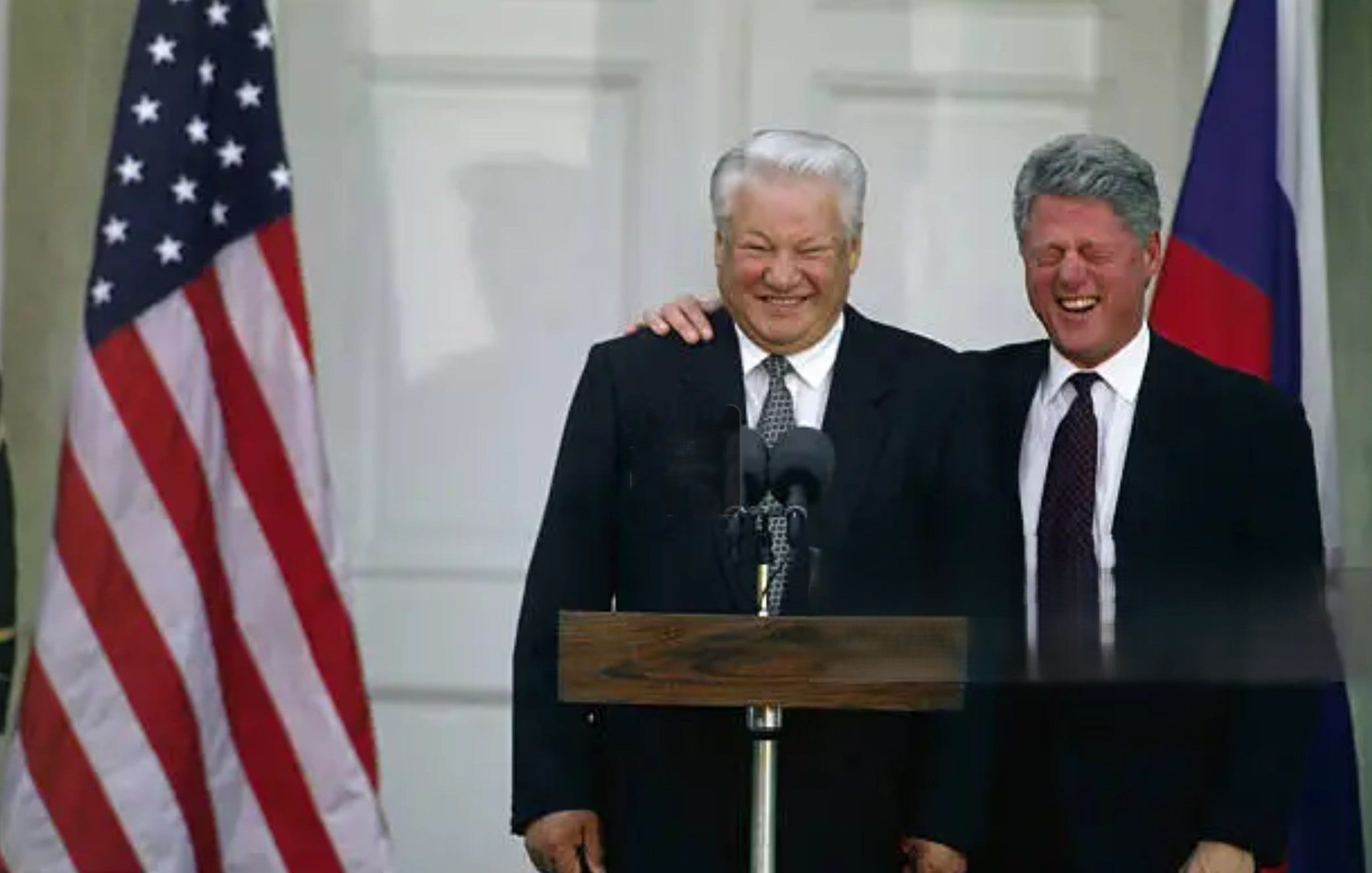
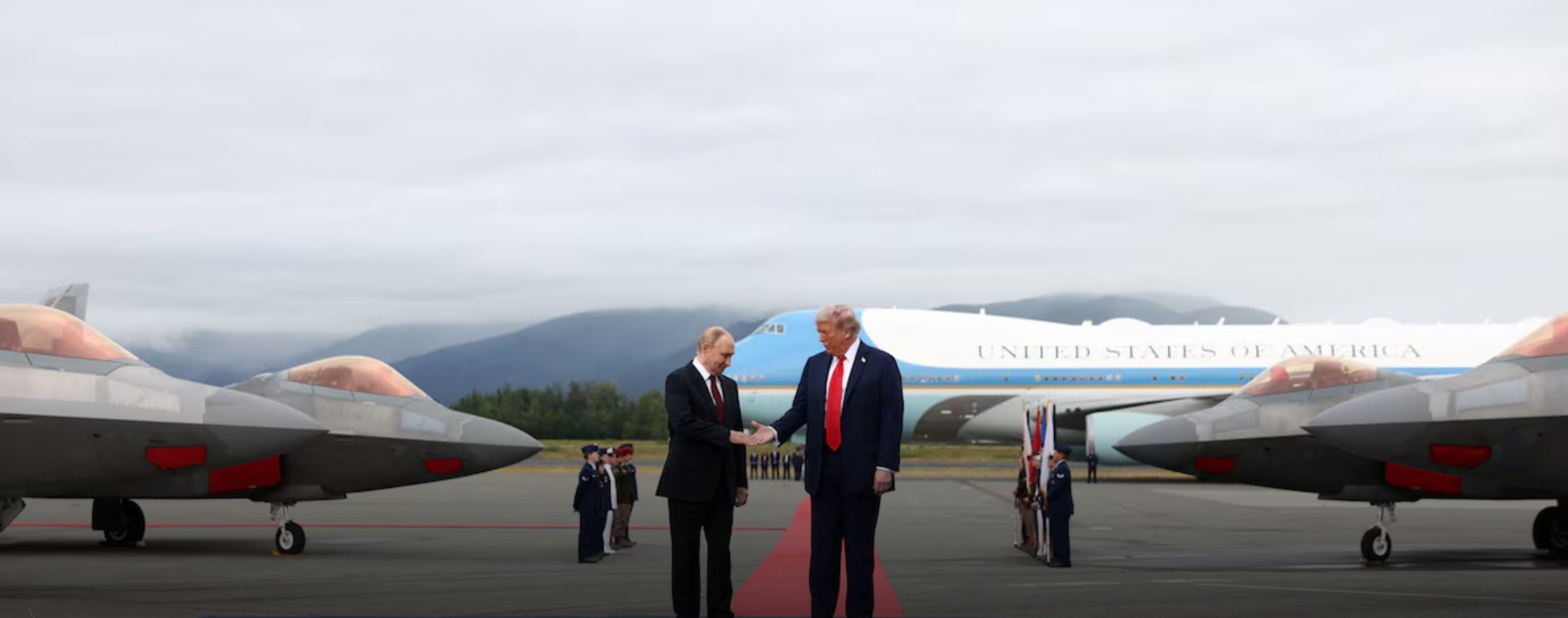
The Alaska summit proves it. The purge is Recreation tocomplete
Russia will be flooded with Western capital, Western consultants, and Western oil companies. The oligarchs will return—but this time, they will answer to London and New York, not the Kremlin. Russia will become a junior partner in the US-led order: a giant gas station with nuclear weapons, stripped of its empire, stripped of its sovereignty, and stripped of any ability to say ‘no.’
The generals who might have prevented this—the professional generals who could have won the war, or at least fought it competently—were removed from the board. Not by the enemy. By the system. A system that needed them dead to ensure that when the Final Act arrived, Russia would have no one left to resist.
The Alaska summit proves it. The purge is complete. The war was never a war. It was a transaction. And the bill has been paid in blood.
The Verdict
We are left with the final, chilling question: Were these men taken by an external enemy, or were they liquidated by the regime?
We may never find the smoking gun or the direct order. But in the architecture of the “managed decline,” the distinction is irrelevant. Whether the trigger was pulled by a foreign saboteur or a state-sanctioned hand, the target was selected by the same authority. The absence of protection was not an error; it was the signal. In this war, the enemy is not just at the gate—the enemy is the system itself.
Yet the system does not exist in isolation. It is fed, funded, and permitted by a larger architecture of interests. The energy markets of Europe, the industrial relocation to America, the long shadow of the 1990s reset—all of these converge on the same conclusion: the war is not a conflict. It is a process. A process designed to hollow out Russia, sacrifice Ukraine, and deliver the final prize to the only power that stands to gain from every angle of this catastrophe.
The generals were not victims of war. They were obstacles to a peace that was never meant to come. And the proof is not in the bomb that killed them—it is in the silence that followed. The silence of a world that watches, consumes, and waits for the next act.
When that act arrives—when Zelensky is discarded, when the US embraces a weakened Russia, when the 1990s return—remember who was removed from the board to make it possible.
The suspicion is not a guess. The pattern is the truth. And the truth is the indictment.
Throughout this six-part series on Putin's treason—from the death of Prigozhin to the architecture of the managed decline—the final verdict is written not in classified documents, but in actions, inactions, and the systematic bleeding of Russia. Putin is a CIA asset, cultivated during his years in Germany and elevated to power to finish what Yeltsin started: returning Russia to the absolute corporate control Washington held in the 1990s.