The most terrifying aspect of modern techno-fascism is how quietly it speaks. It does not arrive with the dramatic, visceral thunder of a tyrant’s decree; it arrives via a carefully formatted corporate press release, written in the bloodless, sanitized dialect of “digital transformation” and “scalable public infrastructure.”
GENOCIDE as a background setting
When Alphabet CEO Sundar Pichai signed off on Project Nimbus—a $1.2 billion central nervous system providing advanced AI data processing and automated targeting capabilities to a military apparatus (GENOCIDE), he did not view himself as a man bargaining with an existential evil.
It is Good to remeber history: At Nuremberg, it was not only officers who were convicted. The industrialists who supplied the means were convicted too. What is reprehensible today is that the suppliers of the digital means remain free men.
In the sterile cleanrooms of global capitalism, there are no demons. There are only metrics, cloud workloads, and the unyielding, religious dictate of fiduciary duty to institutional shareholders.
To dismantle this illusion of corporate inevitability, we must reject the convenient myth of the “helpless executive” trapped by his board. The global CEO is not a panicked child cowed by the machinery of Wall Street; he is its highly compensated, willing enforcer.
We know this because the myth of executive powerlessness was permanently shattered earlier this year by Dario Amodei.
When the United States military apparatus demanded that Anthropic strip the safety guardrails from its AI models to enable autonomous weapons systems, Amodei did what Pichai claims is structurally impossible: he publicly drew a line in the sand and said no.
He weaponized transparency, forced the conflict into the open public square, and used Anthropic’s public-benefit charter to shield his moral agency from a predatory state. Amodei proved that the corporate cage is not a law of physics; it is a choice.
To understand why a man like Pichai chooses to reject that courage—why he chooses to trade human moral agency for the clinical safety of the corporate machine—we have to look directly at the cultural and psychological laboratory that engineered his mind. Pichai’s trajectory from a middle-class upbringing in 1970s Madras to the absolute summit of Silicon Valley power is not a story of individual genius.
It is a masterclass in the convergence of two of the most ruthlessly efficient systems of mass control ever devised: the ancient, stratified psychology of the Indian caste system and the hyper-modern, blind optimization of the corporate extraction engine. The architecture of absolute compliance begins with an inherited, historical blind spot.
For millennia, the structural foundations of the caste system functioned on a specific, deeply internalized definition of duty—one where a person’s moral worth was measured entirely by their flawless, contamination-free adherence to their prescribed role within a rigid social hierarchy. In this framework, the administrator or the clerk does not possess the moral right to question the violence of the sovereign; to do so would break the cosmic order. Your only obligation is the execution of your technical labor.
When that ancestral conditioning is transplanted into the competitive gauntlet of the South Indian meritocracy—the hyper-sterile, rule-bound pipeline of the Indian Institutes of Technology (IIT)—it creates a psychological cleanroom. Engineering and mathematics are treated as purely technical math problems completely divorced from human ethics. The student is trained meticulously to optimize systems, please authority figures, and achieve flawless execution, while being entirely hollowed out of moral imagination. Where an Amodei sees an existential boundary that must be defended, a product of this specialized engineering sees only a workload to be delivered.
II. The Laboratory of Scarcity and the Nalla Paiyan
To understand the architecture of this compliance, one must visit the residential streets of Ashok Nagar, Madras, in the 1970s and 80s. This was the era of the “License Raj”—a landscape defined by bureaucratic gridlock and state-enforced scarcity. In a society where families waited years for a basic rotary telephone or a Vespa scooter, security was a fragile, guarded commodity.
In this specific socio-cultural environment, the highest praise a young boy could receive was to be labeled a nalla paiyan—the “good boy.” Within the strictures of the Tamil middle-class elite, a nalla paiyan is not a free thinker, a rebel, or an agent of systemic disruption. A nalla paiyan is an instrument of pure institutional alignment. He scores top marks, obeys the structural hierarchy without question, and avoids social friction at all costs. Radical moral conviction is viewed not as a virtue but as a dangerous liability that threatens the family’s upward mobility.
Pichai internalized this blueprint perfectly. The boy who astounded his family by effortlessly memorizing every phone number dialed on their first rotary telephone grew into a man who views the world through data structures and systems optimization.
When your formative years are spent navigating a landscape of scarcity under the dictates of rigid obedience, your primary psychological drive becomes the preservation of attained security. For an executive who climbed from a cramped, two-room apartment to a position of global tech hegemony, the raw survival instinct of the nalla paiyan remains dominant: protect the hierarchy, satisfy the superiors, and never rock the boat.
III. The Execution of the Imperial Contract
This brings us to the operational reality of Alphabet under Pichai’s custodianship. When the internal friction of human conscience attempted to interrupt the flows of capital, Pichai did not act with the hesitation of a conflicted leader. He acted with the precise, clinical coldness of the ultimate bureaucrat.
When over 50 Google employees organized sit-ins and protests under the “No Tech for Apartheid” banner to oppose Project Nimbus, Pichai did not engage the moral weight of their argument. Instead, he summary-fired them, releasing an internal memo that explicitly demanded employees leave their politics at the door. He treated dissent not as a vital ethical alarm but as a system anomaly—a disruption to workplace efficiency that had to be purged.
This is where the ancient caste mindset and the modern corporate extraction engine achieve perfect synthesis. In the corporate logic of Big Tech, military infrastructure is reframed as a neutral commodity. Providing automated tracking systems, cloud processing, and data silos to an army engaged in mass violence is sanitized under the banners of “digital infrastructure monetization.” By transforming lethal realities into bloodless engineering workloads, the corporate clerk insulates himself from the moral consequences of his signature.
IV. The Choice of the Custodian
The ultimate indictment of Sundar Pichai is that his powerlessness is a carefully manufactured lie.
The system rewards him with hundreds of millions of dollars precisely to carry out these choices, acting as the human shield for institutional wealth. He is not a victim of the corporate cage; he is its master locksmith.
Dario Amodei demonstrated that an alternative reality exists. A tech leader can choose to look at a multi-million-dollar defense contract, recognize the weaponization of their technology, and weaponize the open public space to say “no.” It is dangerous, it is volatile, and it invites the immediate wrath of state power and financial boards—but it is entirely possible.
Pichai’s compliance is a daily, active choice. He chooses the smooth continuity of the extraction engine over the messy disruption of human ethics. He remains the perfect clerk of the modern sovereign: a man engineered by history, culture, and capitalism to ensure that the machinery of techno-fascism never encounters the friction of a human soul.
V. The Rupture on the Stage
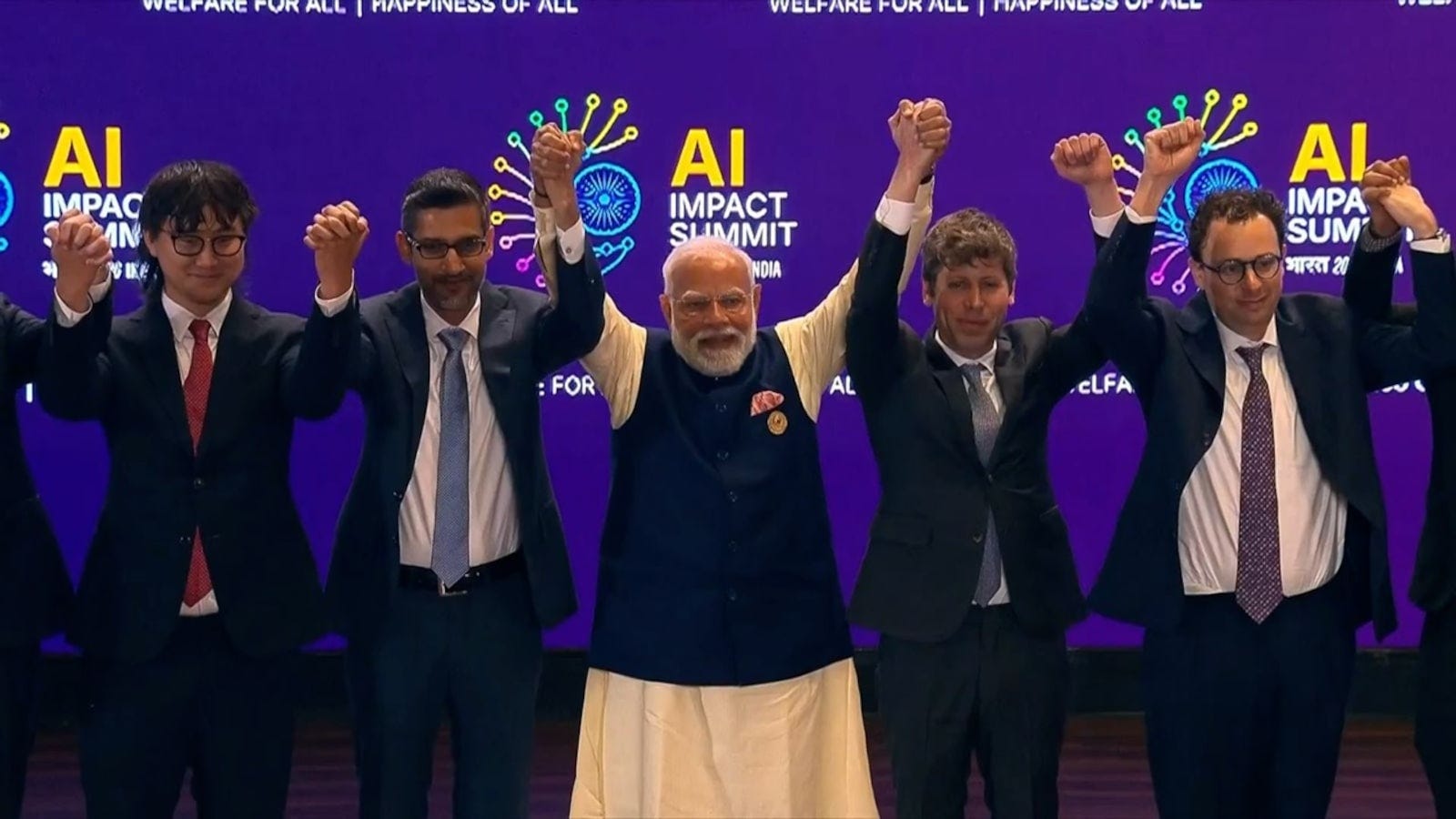
Look closer at the image of the New Delhi stage, and you will see the exact moment the corporate cage cracked.
When Prime Minister Modi nudged the assembled tech barons to lock arms and raise them in a theatrical chain of absolute, unquestioning unity, the compliance was seamless on the right. There stood Sundar Pichai, the textbook nalla paiyan, holding the sovereign’s hand high, fulfilling his role as the obedient clerk of the empire. [1, 2]
But follow the chain further down the line, and the illusion of complete submission shatters. Standing side-by-side, Dario Amodei and Sam Altman refused to link arms. Amidst a row of smiling, compliant executives performing a forced ritual of technocratic solidarity, Amodei chose a conspicuous, awkward resistance. He raised a closed fist instead, refusing to allow his body or his brand to be seamlessly integrated into the sovereign’s photo-op. [1, 2, 3, 4]
It was a subtle, silent act of defiance, but he was the only MAN STANDING among a bunch of trained seals in the open public square; that gesture, it spoke volumes. It proved that even when standing under the direct gaze of state power and surrounded by the intense social pressure of your peers, you can still refuse the handshake.
It separates the men who view their survival as entirely dependent on pleasing the master from the ones who understand that their moral lines are non-negotiable. Pichai raised the sovereign’s arm; Amodei kept his fist independent. In that single snapshot, the difference between the custodian and the dissenter is permanently exposed. [1, 2, 3]
A Note on Sovereignty:
The Dissenter is 100% free, uncompromised, and carries zero corporate ads or algorithmic sponsors. This archive is funded entirely by reader sovereignty.
If you value independent intellectual critique, consider backing this work for $5/month. Supporters also unlock the complete audio-narrated mythic sci-fi saga, Arca of Itharion.