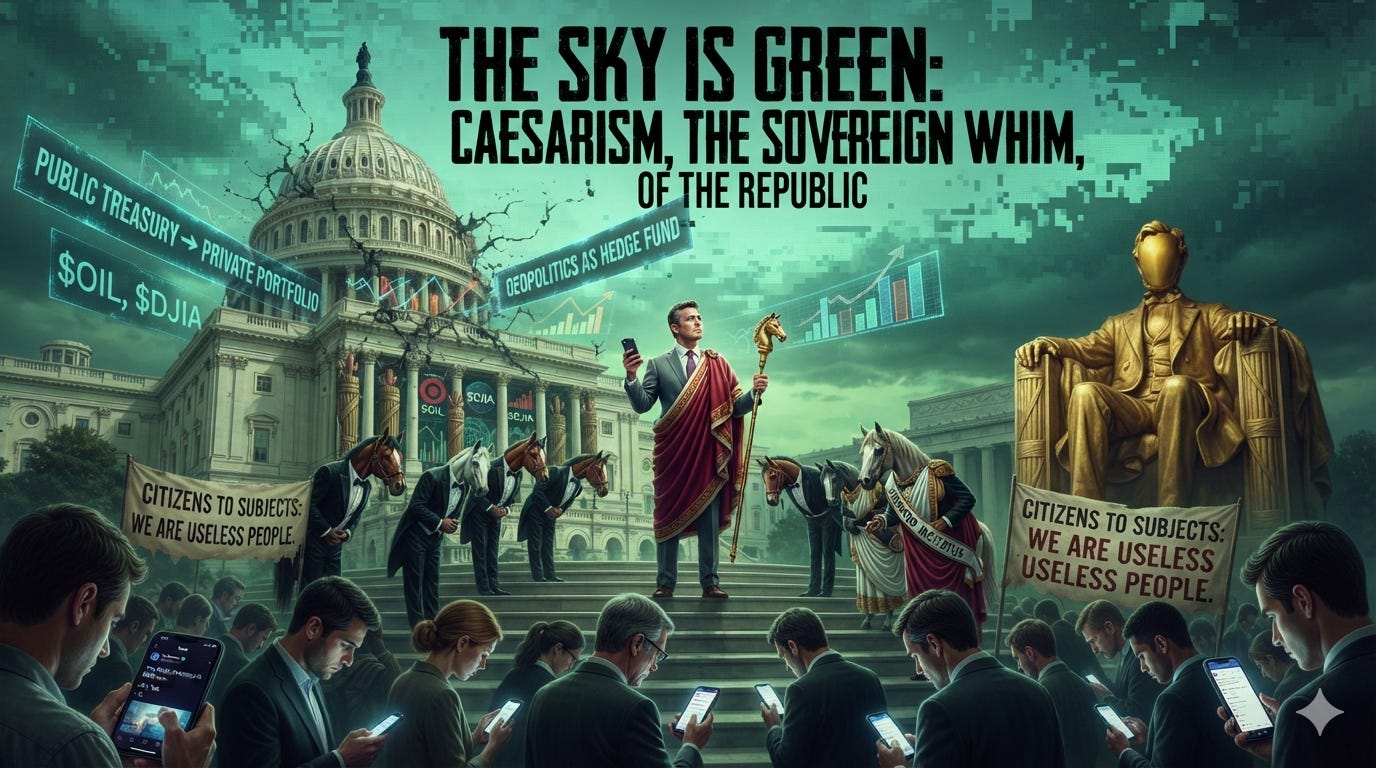
Caesarism describes the historical transition from a constitutional republic to an autocracy, where institutional norms are replaced by the unpredictable whims of a sovereign leader, a dynamic increasingly visible in modern American politics.
There is a distinct, agonizing stage in the collapse of any great empire where the law ceases to be objective rules and becomes instead a series of personal moods. To live in the late-stage American empire today is to experience the constant, exhausting whiplash of this transition. It is the moment where the state stops pretending to be a constitutional republic and reveals itself as a court—a family-run fiefdom where the population are no longer citizens but merely subjects of a chaotic, unpredictable theater.
The blueprints of Rome's transition from a proud, albeit flawed, Republic to the absolute rule of the Caesars are being followed almost line-for-line in Washington today.
I. The Hollow Shell of the Republic
Both the late Roman Republic and modern America share the same terminal symptom: the hollowing out of institutions.
In the decades leading up to the rise of Augustus Caesar, the Roman Senate still met. Magistrates were still elected, laws were debated, and the old patrician families wore their formal togas to the Forum. But it was a hollow pantomime.
Real power was held by a tight circle of oligarchs, military warlords, and private financiers who controlled the grain supplies and commanded the loyalty of the legions.
Similarly, the modern United States maintains the elaborate, multi-billion-dollar theater of representative democracy. Congress votes, elections are held, and pundits on television debate policy with practiced gravity. Yet, the foundational decisions of the state are completely decoupled from public input.
The citizen has been demoted to a spectator. Elections are no longer an instrument for structural change; they are a periodic pacification ritual designed to make the "subjects" feel as though they have a hand on the wheel, even as the vehicle is driven off a cliff.
II. The Sovereign Whim (The "Green Sky" Decree)
The true hallmark of Caesarism is not simply authoritarianism but the supremacy of the sovereign whim. Under the early Roman Republic, written law was paramount. By the time the imperial courts of Caligula and Nero took hold, the Emperor's personal whim held the force of law.
When Caligula famously threatened to name his favorite horse, Incitatus, a consul, it was not the act of a simple madman. It was a calculated, theatrical performance of absolute power. By threatening to elevate a beast to the highest office of the state, Caligula was proving to the Senate that their cherished institutions were so thoroughly broken that they would codify a farce just because he willed it.
We witnessed this exact dynamic in July 2026. With a single social media post, President Trump declared the United States "THE GUARDIAN OF THE HORMUZ STRAIT" and demanded a 20% "reimbursement fee" on all transit cargo—a move that flatly violated international maritime law. Within twenty-four hours, after chaos rippled through global oil and stock markets, the decree was quietly abandoned on Truth Social in favor of vague promises of "Trade and Investment Deals" with Gulf states.
While the absurdity belongs to the grotesque, the psychological reality is dark. When Secretary of State Marco Rubio—who only weeks prior had declared that no country had the right to charge transit fees on international waterways—is forced to frantically defend both the sudden toll and its immediate retraction, the state bureaucracy is reduced to royal courtiers.
Their job is no longer to maintain coherent policy but to convince the world that the sky, which was declared green at noon and red by dinnertime, has actually been a dynamic shade of teal all along.
III. The Privatized Empire
In a healthy republic, the state's resources and foreign policies are aligned with the public interest. In a monarchy, the state is the private estate of the ruling family.
As Rome crumbled, the emperor’s private treasury gradually swallowed the public treasury. Imperial provinces were distributed to the Emperor's personal friends and business partners, who ran them like private tax-farming operations.
This is the literal privatization of sovereignty we see today. The execution of high-stakes American foreign policy is no longer trusted to technical experts or career diplomats. Instead, the administration dispatches family members like Jared Kushner and personal real estate billionaires like Steve Witkoff to negotiate international peace treaties and backchannel deals.
The result is a devastating merger of geopolitics and private portfolio management. While the public is fed terrifying headlines of escalating war, a tight inner circle of court insiders reportedly moves global energy markets, shorting oil and going long to pull in billions in speculative profits. The presidency has effectively been converted into a sovereign hedge fund, where a 3:00 AM tweet is not a diplomatic strategy but an insider trading signal.
IV. From Citizens to "Useless Subjects"
Ultimately, this transition transforms the very nature of the population. In the late-stage corporate empire, the elite view of the citizenry is cynical: they are "useless people."
Because the financialized state no longer relies on a robust, educated middle class to project its power, the domestic population is treated as economically redundant. They are a liability to be managed, pacified, and distracted. Like the "bread and circuses" of late Rome, the modern state uses relentless culture wars, algorithmic feeds, and political spectacles to keep the populace looking at the stage rather than the crumbling foundations of the theater.
When the system is this tightly locked down, and the avenues for constructive change are welded shut, "hope" undergoes a grim mutation. The public stops hoping for a better tomorrow and instead begins hoping for the fast, spectacular collapse of the machine itself.
It is a tragic destination. But when a society is forced to bow to a sovereign who improvises reality on a daily basis and where the "senators" are little more than decorative horses, the desire to see the temple fall is not madness—it is the last gasp of a population desperately wishing to touch something real again.