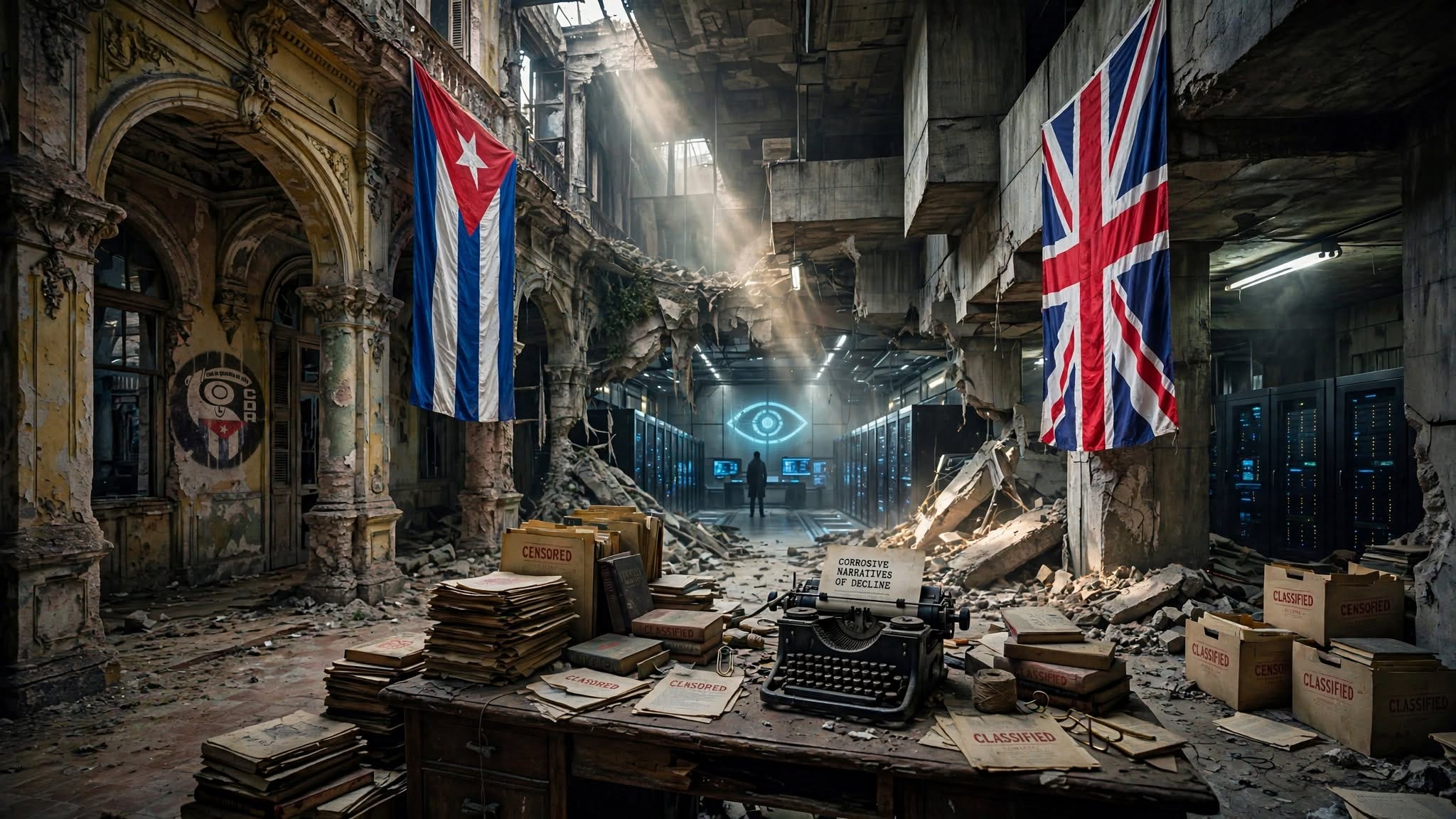
Part 1: The Anatomy of “Corrosive Decline”
Having grown up under the totalitarian machinery of Cuba, I recognized the architecture of state panic long before the first censorship law was formally coded. In Havana, pointing out the crumbling concrete, the failing grid, or the systemic decay was never treated as an empirical observation—it was classified as “ideological diversionism,” “enemy propaganda,” or “defeatism,” and eventually resulted in jail time or ostracism.
Fast-forward to the modern United Kingdom. The Prime Minister takes the global stage at the UN General Assembly to unveil a new state apparatus: the National Centre for Information Defence. Its mandate? To intercept, disrupt, and neutralize what the state deems “untrue narratives” and “corrosive narratives of decline.”
The wording is vague by design, heavy with martial echoes borrowed from the theater of war. To intercept—how? With missiles or police? To disrupt and neutralize—how? By jailing even more citizens for social media posts when the nation’s prison capacity is already bursting at the seams?
Hardly. The military posture isn’t meant to destroy a physical enemy; it is engineered to terrorize the populace into quiet submission. A self-censoring public is the real strategic objective.
Part 2: From the Neighborhood Block to the Silicon Pipeline
The fundamental mistake Western observers make is believing that authoritarianism requires Soviet-era aesthetics: breadlines, military fatigues, and secret police knocking on doors at dawn.
In Cuba, the state relied on the Committees of the Revolution Defense (CDR)—a physical network of neighborhood informants built to monitor the political temperature of every street block.

The UK’s new “Information Defence” hub merely replaces the street informant with the algorithmic filter:
The Intelligence Fusion: By wiring the Cabinet Office directly into the MI5, GCHQ, national police, and Big Tech moderation pipelines, the state creates a closed-loop panopticon.
Proactive Interruption (”Defend Forward”): The shift from passive fact-checking to active “disruption” means preemptive shadowbanning, algorithmic throttling, and structural de-platforming.
The Sterilized Public Square: You don’t need to throw a writer into a physical cell when you can simply set their reach to zero, erase their digital footprint, and label their critique a “foreign-backed psy-op.”
It is the same core impulse—monopolizing the truth—re-engineered for a hyper-connected, risk-averse technocracy.
Part 3: The Monopoly of Truth
When an institution grants itself the authority to define what constitutes a “true” or “untrue” narrative, truth ceases to be an empirical discovery. It becomes a sovereign permit.
The tragedy of late-stage Western governance is its refusal to look in the mirror. As economic models strain and institutional trust collapses, the political class refuses to reform itself. Instead, it turns outward, blaming the unrest on “misinformation” and “disruptive algorithms.”
They are building a digital wall around the narrative, insisting that as long as no one is allowed to speak about the darkness, the light must still be shining.
Announcing a domestic information control apparatus at the United Nations General Assembly isn't just bureaucratic theater—it’s a deliberate act of performative sovereignty. It signals that the state no longer views this as an internal policy matter to be debated in Parliament or scrutinized by the press. Instead, it frames censorship as a matter of international standing, as if silencing its own citizens is a diplomatic achievement worthy of the global stage.
The Sovereign Verdict
The Cubanization of the West will not arrive with a dramatic coup or a military parade. It is already here quietly, wrapped in the sterile language of “national security,” “information defense,” and “social cohesion.”
They call it protecting democracy, where there is none. Those of us who have seen this film before know its real name: the institutional fear of a free mind.
A Note on Sovereignty:
The Dissenter is 100% free, uncompromised, and carries zero corporate ads or algorithmic sponsors. This archive is funded entirely by reader sovereignty.
If you value independent intellectual critique, consider backing this work for $5/month. Supporters also unlock the complete audio-narrated mythic sci-fi saga, Arca of Itharion.