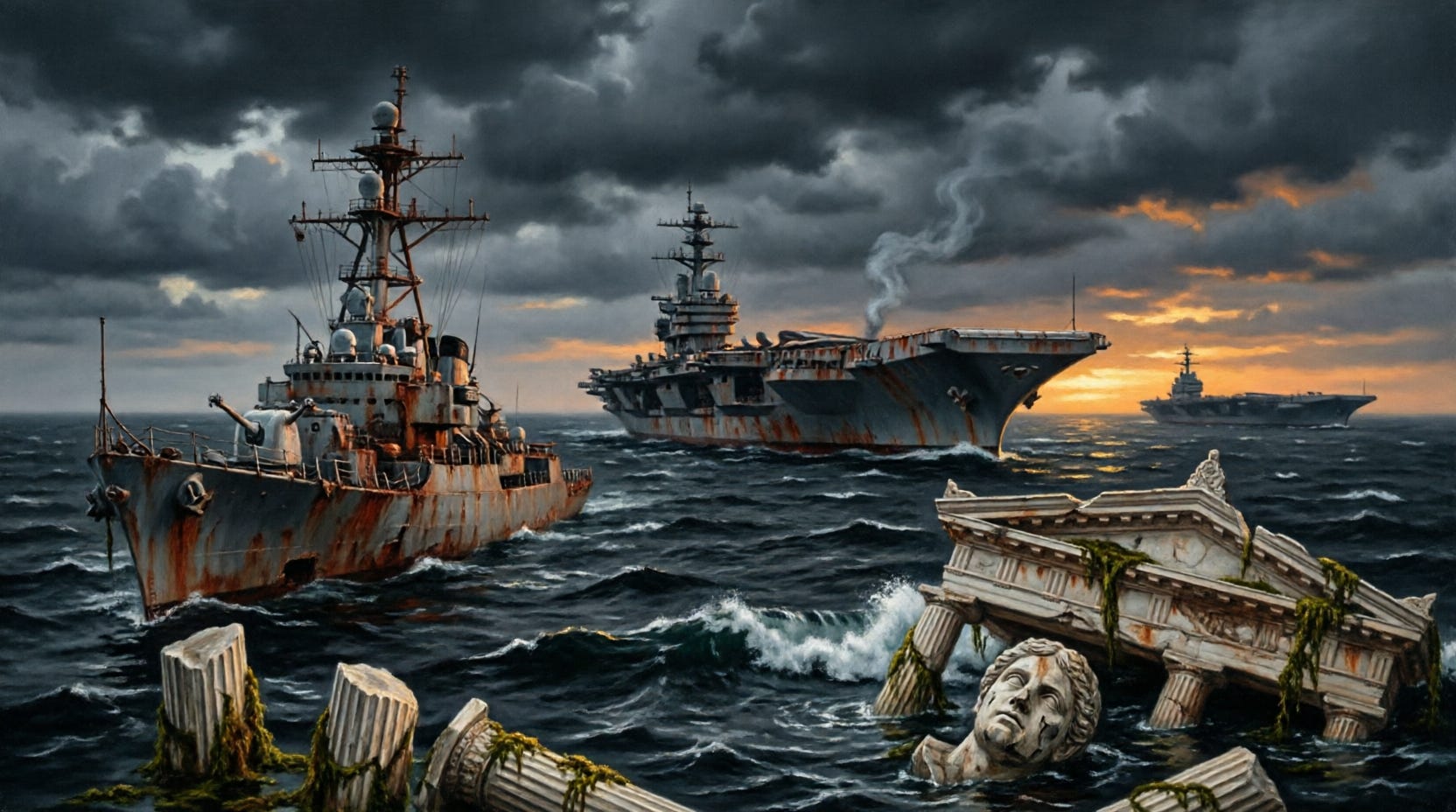
The Caesar is old, and in the senate, the rumor runs wild and fast. It is not loud—not yet. They are afraid still, and the emperor maintains control of the helm. The question on every whispering lip is simple: For how long?
They worry not for the nation. The nation was never in their interest. They couldn’t care less about the unemployed, the poverty always increasing, the cost of life, the education plummeting like a stone down a well, the medicine and medical costs bankrupting the already sick people, the working poor, and the man with an 8-hour job sleeping in a car, unable to be a citizen.
Their devotion belongs entirely to power, money, and position. The capital operates like a well-run, neon-lit brothel where politicians sell themselves to the highest bidder. Invariably, the hand holding the purse belongs to a far-away “David.”
He pulls the strings, dictates the empire’s enmities, and buys off the “Putas” perched on the empire’s power pulpit, turning the nation’s treasury into a ledger of foreign debts. The rot is no longer a temporary affliction; it is institutional, structural, and final.
When future historians dissect the anatomy of twenty-first-century imperial collapse, they will look past the grand political speeches and the hollow claims of global dominance. Instead, they will point to a single, devastating year wherein the summer of 2026 is the moment the illusion shattered completely.
The physical machinery of the old and tired empire broke down, its human foundation reached a breaking point, and the leadership remained utterly blind to the reality on the land and the water.
The Broken Machine: Internal Rot
The USS Benfold
Among the first symptoms of terminal decline is always the decay of vital infrastructure. On July 24, 2026, the USS Benfold, a premier guided-missile destroyer, ground to a sudden halt in the South China Sea.
A catastrophic engineering failure stripped the warship of power, propulsion, plumbing, and climate control, leaving it stranded for four agonizing days. What a joke for China, right in front of "the enemy they want to destroy"; Xi must be pissing himself laughing.
This was not a random fluke of engineering. It was the predictable consequence of a domestic industrial base in total collapse. For years, the empire’s shipyards have suffered from a massive backlog, a shortage of skilled labor, and a lack of critical spare parts.
Multi-billion-dollar vessels are routinely sent into hostile waters “they themselves create” with unresolved mechanical faults because the system no longer has the capacity to fix them or give proper maintenance.
When a superpower can no longer keep the very machines meant to project its power, the foundation of its hegemony has already turned to dust. The only thing standing is an illusion, the ghost of the past.
The Human Toll: Overstretch and Despair on the USS Lincoln
The second symptom is imperial overstretch—the fatal habit of expanding military commitments far beyond what a society’s human capital can sustain. While the USS Benfold drifted, the USS Abraham Lincoln carrier strike group remained trapped in an indefinite losing conflict with Iran.
By August 2026, the crew of the Lincoln had spent over 250 consecutive days at sea without a single port call, breaking modern naval records.
Behind the high-tech facade of a nuclear-powered aircraft carrier lay a humanitarian crisis: acute shortages of food, contaminated drinking water, broken sanitation systems, and pervasive mold. The psychological strain became so unbearable that multiple sailors attempted to jump overboard into the open ocean just to escape the ship.
To mask the strategic void left by this exhaustion, the leadership was forced to abruptly divert the USS George Washington from the Western Pacific to the Middle East. Moving the George Washington to patch the hole left by the Lincoln strips the Asian theater of its primary deterrent. It is the classic maneuver of a bankrupt empire: robbing Peter to pay Paul, shifting a dwindling supply of resources across a map that is simply too large to defend.
The USS Gerald R. Ford (CVN-78)
Chronology of Misfortune
2009–2017: Construction & Cost Overruns
The ship’s delivery was delayed by years due to advanced, unproven technologies.
Costs ballooned to $13 billion, making it the most expensive warship in history.
2017–2022: Technical Breakdowns
Weapons Elevators: The Advanced Weapons Elevators (AWE), which use magnets instead of cables, routinely broke down. The ship deployed without all of them working.
Propulsion Issues: The ship suffered main thrust bearing failures during sea trials, forcing it back to port.
Toilet System: The toilets clog easily, requiring a specialized chemical flush that costs roughly $400,000 per clean.
2023–2024: Extended Deployment
Sent to the Eastern Mediterranean following the October 7 attacks.
Its deployment was extended three times, keeping the exhausted crew at sea for 244 straight days.
March 2026: The Laundry Fire
A catastrophic non-combat fire broke out in the main laundry area and spread through ventilation spaces.
Sailors fought the blaze for over 30 hours.
The aftermath left 600+ sailors homeless on board and forced the ship to limp back into the Mediterranean to dock at Souda Bay, Greece, for emergency repairs.
Key Technical Vulnerabilities
EMALS (Electromagnetic Aircraft Launch System): Replaced traditional steam catapults but suffered low reliability rates, occasionally grounding aircraft.
AAG (Advanced Arresting Gear): The system used to catch landing planes experienced high failure rates during critical testing phases.
The USA is losing war with Iran
The American war machine is bleeding out in the shadow of Iran. According to reports from the Wall Street Journal and BBC Verify, the United States has sustained an estimated $13 billion in hardware losses and facility damage from Iranian drone and ballistic missile strikes. The ledger of ruin is not written in grand strategy. It is written in burnt silicon, shattered radar, and the cold arithmetic of a military stretched past its breaking point.
In the opening days of the conflict, a $1.1 billion AN/FPS-132 early-warning radar system—the eyes of the empire in the Gulf—was struck blind and rendered inoperable. At least twenty military sites across eight countries sustained significant damage: communication hubs, air defense networks, and drone shelters. The infrastructure of omniscience, cracked open.
In the air, the losses compound. Forty-five MQ-9 Reaper drones were destroyed—a quarter of the entire operational fleet, $1.3 billion in unmanned hardware reduced to scrap. Over forty-two manned aircraft damaged or killed outright: F-35 A stealth fighter, an F-15E Strike Eagle, an A-10 Thunderbolt, and a KC-135 refueling tanker. And on the ground at Prince Sultan Airbase in Saudi Arabia, a $700 million E-3 Sentry surveillance plane—the all-seeing eye of the battlefield—was severely damaged, blind, and burning on the tarmac.
This is not a tactical setback. This is a strategic hemorrhage. The empire is spending its irreplaceable assets faster than its broken industrial base can rebuild them, fighting a war it cannot afford to lose and cannot afford to win.
The Senate of Clowns: A Blind Elite
While the empire’s sailors endure squalor and desperation, the ruling elite in the capital remain completely detached from reality. The political class boasts of possessing the most advanced military force in human history, screaming empty promises into a hollow wind. It is a sad and welcome eerie image.
When confronted with the horrifying conditions aboard the Lincoln, the response from the leadership was a mix of denial and indifference. Defense Secretary Pete Hegseth dismissed the crisis as “completely misrepresented,” while Emperor Donald Trump publicly declared that the grueling, record-breaking deployment “wasn’t long enough.” A basic fuck you all; I decide you comply with the imperial edict.
This is the ultimate stage of institutional rot. The ruling class is no longer capable of governing, nor do they care to try. Their focus remains fixed on the transactional politics of the capital, servicing external interests and their own bank accounts while the literal instruments of their power fracture at sea. The emperor and his family and friends enrich themselves regardless of the tragedy. The shorting and longing in the crude oil markets only inflates their already bulging bank accounts.
The Final Anatomy
But this collapse is not merely a failure of logistics or a single administration’s cruelty. It is the final, inevitable shifting of an epoch—the last convulsion of a dying age before the earth turns the page.
As I wrote in the author’s notes of my book ”The Pulse of Angkor”:
“Yet time and people morph everything. The great tectonic plates of history—the pre-industrial, the industrial, and the human epoch itself—bent and then collapsed.
They did not buckle under a glacier or an asteroid but under their own accumulated weight: a crushing geology of human error, vanity, intoxication, cruelty, and a rapacious philosophy that declared all valid under the might of a single measure.
The world fell, not with a bang, but under the mighty last currency, “the dollar.” And a new era began because it was the end of a dying one.
The Humelynn New Era reshaped all human concepts from the very beginning and essence to the stars and far beyond.”
The end days of an empire do not always announce themselves with a sudden, dramatic invasion. More often, they are defined by a quiet, compounding exhaustion. It is the sound of a generator failing on a destroyer in the Pacific. It is the sight of a desperate marine looking at the horizon and jumping into the sea. It is the image of an aging Caesar and a corrupt senate trading barbs in a room filled with echo chambers, entirely oblivious to the fact that the ship they are steering has already begun to sink.