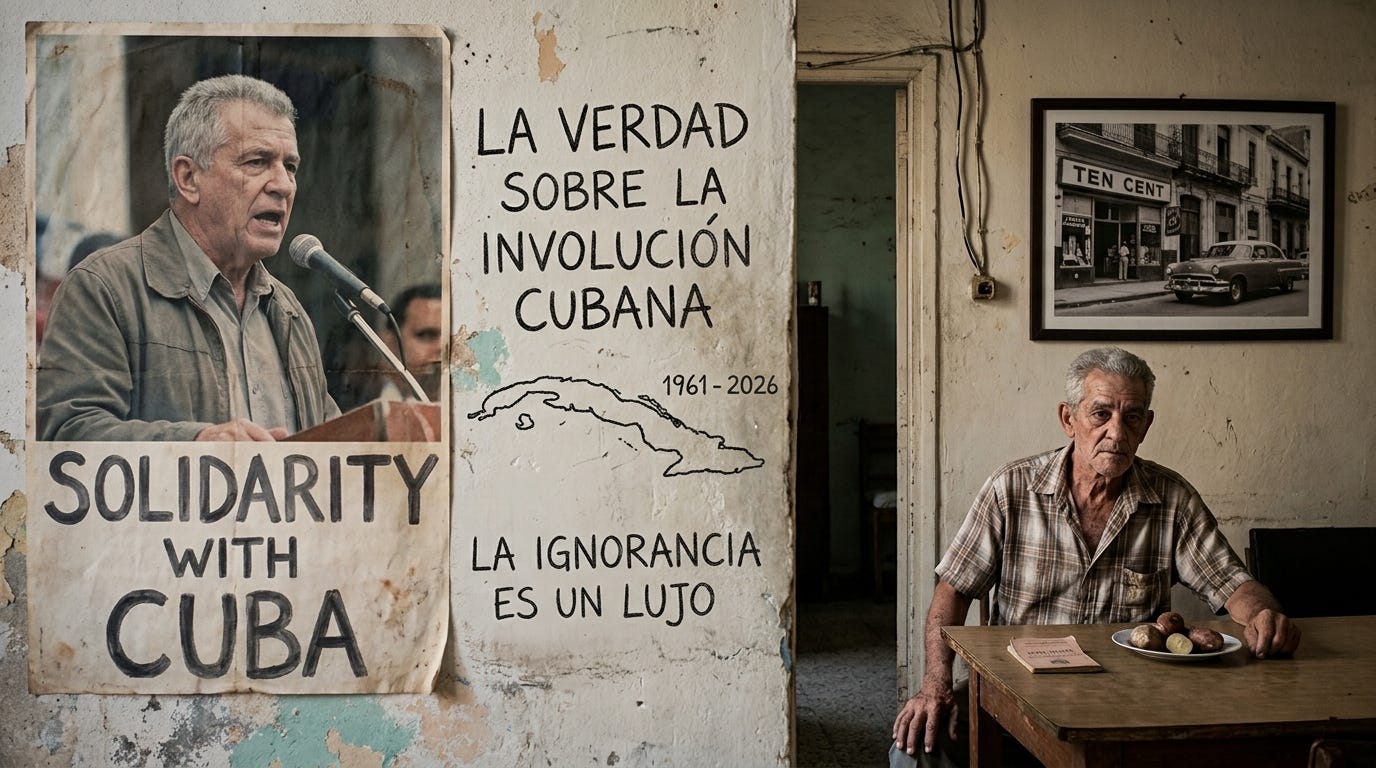
Introduction: The View From the Air-Conditioned Suite
Recently, the former leader of the UK Labour Party, Jeremy Corbyn, returned from a tightly managed, state-chaperoned “solidarity convoy” to Havana. Standing before international cameras, he delivered a prepackaged, ideologically sanitized script: the catastrophic collapse of modern Cuba—the dead electrical grid, the shuttered hospitals, the empty pharmacies—is entirely, exclusively, the fault of the United States embargo.
To Corbyn and the entire ecosystem of Western alternative media that profits off this narrative, Cuba is not a real country populated by starving human beings. It is an abstract symbol in a university textbook. It is a romanticized fairy tale of “socialist resistance” against American imperialism.
They open their ignorant mouths to function as unpaid propagandists for a brutal military dictatorship, insulated from the consequences of their words by the luxury of their British passports and their overflowing refrigerators.
They never ask the exiles. They never spoke to me or someone like me from Cuba.
I was born in Havana in 1961. I spent thirty-one years navigating the suffocating architecture of the Castro regime until I executed my escape in the darkest depths of the Special Period in 1992. I am not a theoretical commentator. I carried my own crucifixion out of that wreckage through time, isolation, and raw pain. And I know that the starvation of my homeland is a domestic blueprint of totalitarian control, not an accident of foreign policy.
Chapter 1: The Kitchen-Counter Metrics of Dignity
The great lie of the 1959 revolution or Involution as I described, is that it inherited a backwards, sub-developed wasteland waiting to be saved by a messiah.
The regime spent decades rewriting history, but the physical archives and the memories of our ancestors destroy the myth.
My grandmother lived on the corner of Calle Virtudes and the bustling commercial calzada of Galiano—the retail heartbeat of Centro Habana. She was a primary school teacher, a regular worker of the Republican middle class. She was not a wealthy elite or a land baron. Yet, in the 1950s, her salary allowed her to regularly board the City of Havana ferry or take a short flight to Miami for shopping trips, because the Cuban peso sat at an unshakeable 1-to-1 parity with the US dollar.
My granny used to tell me a phrase that carries more economic wisdom than Corbyn’s entire political career: “We were poor, but we had a plate of food, detergent to clean our clothes, and soap to wash ourselves. Not with Castro.”
The pre-1959 archives completely validate her kitchen-counter metrics:
The Protein Powerhouse: In 1958, under the Batista regime, Cuba possessed an almost magical 1-to-1 ratio of humans to cattle—roughly 6.3 million people and over 6 million head of cattle. This abundance gave the island one of the highest per capita rates of beef and dairy consumption in the world. Standard dishes like ropa vieja were accessible staples for regular workers, not tourist-only luxury items.
The Consumer Vanguard: Havana did not merely import goods; it manufactured them. Local factories like Crucellas and Sabatés flooded the domestic market with high-quality soaps and detergents. Calle Galiano was anchored by world-class department stores like Fin de Siglo, La Época, and the American giant F.W. Woolworth (Ten Cent).
The Architectural Matrix: Havana was an international beacon of modern engineering. While Miami was still a nascent, seasonal tourist stop, Havana was erecting modern marvels like the FOCSA rascacielos, the subaquatic Havana Tunnel, and the structural masterpiece of Max Borges Jr.’s Arcos de Cristal salon at the Tropicana Cabaret—a venue so advanced it won the Gold Medal from the College of Architects and was celebrated by the Museum of Modern Art in New York.
Cuba was the second country in the world to establish regular color television broadcasting. On March 19, 1958, Gaspar Pumarejo launched Telecolor Channel 12 from the facilities of the Havana Hilton, utilizing the American NTSC standard and cutting-edge technology patented by RCA. [1, 2, 3, 4, 5]
This historic milestone meant that Cubans were watching regular, full-color programming well before the vast majority of the developed Western world—including Europe and the UK—which didn’t implement color television infrastructure until nearly a decade later in 1967. [1, 2, 3]
The Railroad Pioneer: Cuba was the first country in Latin America (and the third in the entire world, right after the UK and the US) to build a railroad network, launching it in 1837—long before Spain, its own colonial master, even laid its first track.
Urban Transit: Havana introduced the first electric streetcar system in the region and ranked second in Latin America for per capita automobile ownership. [1]
Caloric Abundance: Cuba ranked third in Latin America in per capita food consumption. Unlike the post-1959 collapse into extreme rationing and scarcity, the pre-revolutionary population fed itself abundantly on real, accessible protein. [1]
Purchasing Power: The island ranked fifth in the hemisphere in per capita income. This wealth generated a thriving domestic market capable of importing high-end goods while fueling advanced local manufacturing. [1]
Medical and Social Metrics
The Healthiest Baseline: While modern propaganda claims the state invented Cuban medicine, the archives show that Cuba possessed the lowest infant mortality rate in Latin America—and the 13th lowest in the entire world—before 1959.
Life Expectancy: The island ranked third in Latin America for life expectancy and 56th globally, operating with a medical infrastructure that resembled Southern Europe rather than a developing nation.
Advanced Literacy: Long before the heavily politicized literacy campaigns, Cuba’s literacy rate sat at 76%—the fourth highest in Latin America. [1, 2, 3]
Telecommunications and Mass Media
The First to Light Up: Hand in hand with its infrastructure, Cuba was the first country in the Americas to install centralized electric public lighting and streetcar networks.
Mass Communication: By 1928, Cuba boasted 61 active radio stations, positioning it fourth globally. By the mid-1950s, it ranked first in Latin America and fifth in the world for television sets per capita. [1, 2, 3]
The Cuban constitution of 1940
Before the system was broken, Cuba didn’t just have an advanced economy—it possessed what international legal scholars widely considered one of the most progressive, visionary, and advanced democratic constitutions on the planet.
It wasn’t a document written for elites; it was a masterpiece of progressive social democracy designed precisely to protect the common worker, long before the rest of the world caught up.
Why the 1940 Constitution Was Light-Years Ahead
When the delegates assembled in Guáimaro and Havana to write it, they built a legal matrix that was revolutionary in its true sense, protecting human dignity through the law:
Unmatched Labor Rights: It legally established the maximum 44-hour workweek (with pay for 48 hours), mandated one month of fully paid vacation for every worker every single year, and created a mandatory minimum wage system.
Total Social Safety Net: It introduced universal social security, outlawed racial and gender discrimination in the workplace, and guaranteed equal pay for equal work.
Land Reform and Education: It explicitly prohibited large, unchecked foreign-owned land monopolies (latifundios) and dedicated a massive, fixed percentage of the national budget strictly to public education and teacher salaries—the very system that allowed my grandmother to thrive as a primary school teacher.
The Ultimate Betrayal of the Law
This is what makes the “savior” narrative of Castro’s image so deeply fraudulent. The people of Cuba did not need an authoritarian system to grant them rights; they already possessed a brilliant, legal democratic framework that not many nations had at the time.
The tragedy is that the law was systematically assassinated twice:
First, by Fulgencio Batista’s coup in 1952, which suspended the 1940 Constitution.
Second, by Castro, who claimed he was fighting to restore the 1940 Constitution, but instead destroyed it entirely. He replaced a highly advanced legal document built on individual rights and labor protection with a totalitarian monopoly where the state became the sole landlord, employer, and judge.
Immigration to Cuba
Between 1902 and 1930, over 1.3 million Europeans legally immigrated to Cuba to build their lives, open businesses, and raise families. The vast majority were Spaniards (including Galicians, Asturians, and Canarians), alongside tens of thousands of Italians, Germans, and European Jews escaping hardship or persecution back home.
During the early 20th century, Cuba was seen across the Atlantic in the exact same light as the United States or Argentina—it was a beacon of hope and a premier global destination for upward mobility.
Why Europeans Desired Cuba over the Rest of the World:
A Financial Superpower: The Cuban peso was so strong and backed by such immense agricultural wealth that it sat at a permanent 1-to-1 parity with the US dollar. A European laborer sending money back home to Galicia or Naples was sending high-value capital that could completely transform their family’s fortunes back in Europe.
The Safety Net of the Mutualistas: Long before modern European states created universal healthcare, the Spanish immigrants in Havana built the Asociaciones de Dependientes and the Centro Gallego/Asturiano. These were massive, palatial mutual-aid societies that provided ordinary members with world-class hospitals, sanitariums, schools, and theaters for pennies a month.
A Magnet for Elite Craft: Because Havana was a global vanguard of architecture, television, transit, and infrastructure, European engineers, artists, and chefs rushed to the island to practice their craft at the highest level.
This was the country the “savior” inherited. A nation that possessed the first shopping centers in Latin America and fed its population abundantly using traditional, fuel-free agriculture like oxen and crop rotation long before modern tractors were even a necessity.
Chapter 2: Hunger as a Weapon of the State
When the revolution nationalized the economy, it didn’t liberate Cuba from foreign monopolies; it destroyed the independent Cubanized economy.
By 1958, the vast majority of sugar mills, banks, and retail stores had been bought out and were owned legally by Cubans. Castro’s “Agrarian Reform” was nothing more than an armed state confiscation of domestic wealth.
Once the state became the sole landlord, the sole employer, and the sole grocer, it implemented the Acopio—a hyper-centralized agricultural monopoly.
Private farmers were criminalized if they attempted to slaughter their own cows or sell milk and root vegetables (viandas) to their neighbors. Private property of shops or businesses was shut down 100%
Every ounce of food had to be surrendered to bureaucratic bailiffs in Havana at artificially depressed, state-mandated prices.
This was not economic mismanagement; it was structural subjugation. By outlawing independent food production and forcing the population to rely on a shrinking state ration book (la libreta de abastecimiento), the regime engineered hunger as a highly effective tool of political control. A starving population does not have the energy to organize a rebellion. When stepping out of line means your state-controlled access to a tiny, monthly pound of chicken is cut off, compliance becomes a matter of raw survival.
To put this structural cruelty into perspective, look at the historical math: In 1842, the Spanish colonial crown issued a royal decree regulating the minimum treatment of enslaved people in Cuba, mandating that masters provide at least 6 to 8 ounces of meat or fish daily to keep them fit for forced labor, under the Bando de Gobernación y Policía / Reglamento de Esclavos de 1842 (Capitán General Jerónimo Valdés, Artículo 6)
Mandated and strictly regulated the obligatory food rations that masters were legally required to provide to their enslaved laborers.
The article specified the following requirements:
Frequency: Enslaved people had to be provided with two or three meals per day.
8 ounces (half a pound) of meat or codfish (ocho onzas de carne o bacalao).
4 ounces of rice, flour, or legumes.
6 to 8 plantains (or their equivalent in sweet potatoes, yuca, or yams)
To argue that the colonial code sought to maintain high caloric and nutritional baselines for the population's growth, researchers point to the mandates for youth: [1]
Article 8: Mandates that newly born or young enslaved children be fed light, nutritious foods such as soups, atoles (corn flours), and milk until they are done teething and weaning. [1]
Article 10: Dictates that if a nursing child falls ill, the mother must be immediately pulled from field labor and assigned to domestic work so she can dedicate herself to breastfeeding and nursing the infant. [1]
Article 13: The Right to Self-Sustenance and “Provision Grounds”
Beyond what the masters provided, Article 13 granted enslaved people the right to work for themselves on Sundays, holidays, and during their daily rest hours to “acquire wealth and purchase their freedom” (adquirir peculio y proporcionarse la libertad). [1]
Historians like Manuel Moreno Fraginals (El Ingenio) point out that enslaved Africans used this time to cultivate "provision grounds" (conucos) where they raised pigs, chickens, and vegetables. This allowed them to supplement their diet with traditional dishes like fufú, congrí, and ajiaco. Commentators argue that under the Castro regime, strict centralized agricultural policies, state-controlled distribution (Acopio), and laws heavily penalizing the private slaughter of livestock (especially cattle) actively criminalized the very type of independent food production that slaves legally practiced on Sundays. [1, 2, 3, 4, 5]
Today, under the absolute collapse of the socialist Acopio, the monthly ration has dwindled to a single pound of chicken per month—fractions of an ounce per day.
The tragic joke whispered on the streets of Havana tells the absolute truth: “Now we are slaves, but without the food.”
Chapter 3: The Anatomy of the “Solidarity” Funnel
Why do political tourists like Jeremy Corbyn and others refuse to see this? Why do they step off their planes, look directly at an island systematically starved into a physical and moral cemetery, and choose to blame an external embargo?
The answer is twofold: ideological armor and financial branding.
First, within the Western leftist framework, the United States is the ultimate global villain; they are not wrong, but for Corbyn’s ideological worldview to remain intact, Cuba must remain a pristine, unblemished symbol of anti-imperialist resistance.
If he were to admit that the Cuban dictatorship is a corrupt, military oligarchy (now operated by the military conglomerate GAESA to build luxury tourist hotels while domestic hospitals lack basic aspirin), his entire theoretical universe would shatter. He chooses pretended ignorance to protect his textbook narrative.
Second, there is a lucrative economy built on this simulated solidarity. If you look underneath the digital content, the interviews, and the speeches celebrating the Cuban regime, you will invariably find the digital funnels: links to Patreon accounts, books for sale, and donation buttons for solidarity campaigns. The real, grinding agony of the Cuban people is converted into digital currency to fund the domestic political careers and branding of Western radicals.
They use the bodies of starving Cubans as human shields to fight their own domestic political wars against capitalism in London, Paris, and Berlin.
Chapter 4: The two embargoes
When the badly called “revolution” better the involution nationalized the economy, it did not liberate Cuba from foreign monopolies, as it claimed. It destroyed the independent Cuban economy—and it did so while telling the world it was only taking American property.
That was the lie. On 13 October 1960, the state passed Law 890 and expropriated 382 large Cuban-owned enterprises: 105 sugar mills, 18 distilleries, 60 textile factories, 13 department stores, 8 railway companies. The same day, Law 891 nationalized private banking. These were Cuban assets, Cuban capital, Cuban families—not American ones. The decisive blow of October 1960 fell on Cubans. Castro’s “I am nationalizing US interests” was the cover story for taking Cuban property first.
And it did not stop there. In 1968, the so-called “Revolutionary” Constitution but Offensive closed and confiscated every remaining private business on the island—52,000 to 58,000 establishments, the overwhelming majority of them in Cuban hands. The count is not abstract: 11,878 grocery stores, 3,130 butcher shops, 3,198 bars, 8,101 food establishments, 6,653 laundries, 3,643 barbershops, 4,544 auto repair shops, 3,345 carpentry workshops. The corner store, the barber, the carpenter, the woman who ran the fonda—all of it, gone, under the banner of eliminating "parasitism."
So understand what actually happened. The first embargo on Cuban food was not imposed in Washington. It was imposed in Havana, by the Dictatorship on Cubans. The US embargo restricts what Cuba can buy abroad. The Castro embargo restricted what Cubans could grow, slaughter, and sell to each other. One is a foreign policy. The other is the direct cause of the empty plate. And both were agreed upon by them
The land was confiscated by force, the private food economy was criminalized, and the ration book replaced the market. The hunger arrived with the libreta (rationing card), not with the sanctions. And when the tractors died in the Special Period, the island went back to oxen—and the oxen worked. The soil could still feed Cuba. What stopped it was never the absence of diesel. It was the state’s refusal to let Cubans feed themselves.
That is the dictatorship’s embargo. Everything after is the alibi.
The collusion of the USA government and Castro's regime will be clarified in the next essay: The Corporate Coup of 1959: Why Wall Street and Florida Secretly Owe Everything to Fidel Castro
Conclusion: Beware the Monopolies of Permission
The trajectory of Cuba from a wealthy, self-sustaining republican powerhouse to a crumbling state-run ruin is a universal warning. When a society trades its economic freedom and private property rights for the grand promises of a centralized “savior,” it enters a corral from which there is no simple physical exit. There are exceptions, and China is one of them, as is Vietnam.
The lesson I learned as a self-deprogrammed dissident in the offices of the port of Havana—a lesson I bought with time, isolation, and pain—is that totalisms always share the same spinal cord. They always seek to enclose the Cartesian plane, whether it is the dirt under your feet, the food in your kitchen, or the thoughts in your head.
Today, sitting in the United Kingdom, I watch the same architecture of permission slowly creeping across the West. The methods have mutated; the iron fist of the Acopio and the neighborly chivato (informer, snitch) of the CDR (Committee of Defense of the Revolution) have been replaced by the slick, clean, and silent algorithms of the tech monopolies and the financialized extraction of modern housing bars.
The modern serf now buys and pays a monthly subscription for the very device that tracks his location, filters his expressions, and monitors his non-compliance. The chivato of the neighborhood is now carried willingly in the pocket.
To the Jeremy Corbyns of the world, I say this: Keep your simulated solidarity. Keep your blind corporate alignment with total state power. Your textbooks are thin, your theories are bankrupt, and your ignorance is a luxury paid for by the hunger of my people.
We are done being told by men who have never risked anything what the price of survival looks like.
A Note on Sovereignty:
The Dissenter is 100% free, uncompromised, and carries zero corporate ads or algorithmic sponsors. This archive is funded entirely by reader sovereignty.
If you value independent intellectual critique, consider backing this work for $5/month. Supporters also unlock the complete audio-narrated mythic sci-fi saga, Arca of Itharion.