Caerith Alondar
Aug 01, 2026
When a police state capable of tracking a single dissident across a city of fifteen million people suddenly experiences a simultaneous system failure in front of a high-ranking military gathering, The Dissenter asserts The Dissenter asserts this was not a breach of security—it was an executed internal purge planned directly from the top.
The Illusory “Surprise” at Kudrinskaya Square
In the strategic playbook of a hyper-centralized autocracy, the failure to protect top military commanders is routinely rebranded as “enemy cunning” or “individual negligence.” But spatial geometry and institutional architecture do not care for bureaucratic excuses.
The site of the attack—the exclusive Balzi Rossi restaurant, nestled into the ground floor of the historic Stalinist skyscraper on Kudrinskaya Square—is a textbook example of a highly controllable urban bottleneck. Tucked away from high-velocity thoroughfares, with strict access corridors along Bol’shoy Konyushkovsky Pereulok, securing this venue did not require an army. It required a simple, standard VIP protocol:
A 100-meter vehicle checkpoint ring.
A mandatory courier and package intercept station.
A basic pedestrian metal-detector filter.
To suggest that a courier carrying a high-yield explosive package could casually walk up to the open-air terrace of a venue hosting top General Staff officers and detonate the payload without triggering a single alarm is a statistical impossibility in modern Moscow. It requires us to believe in a miraculous, simultaneous blackout of the most formidable surveillance state on earth.
The Target and the Casualties: A Gathering of Mandarins
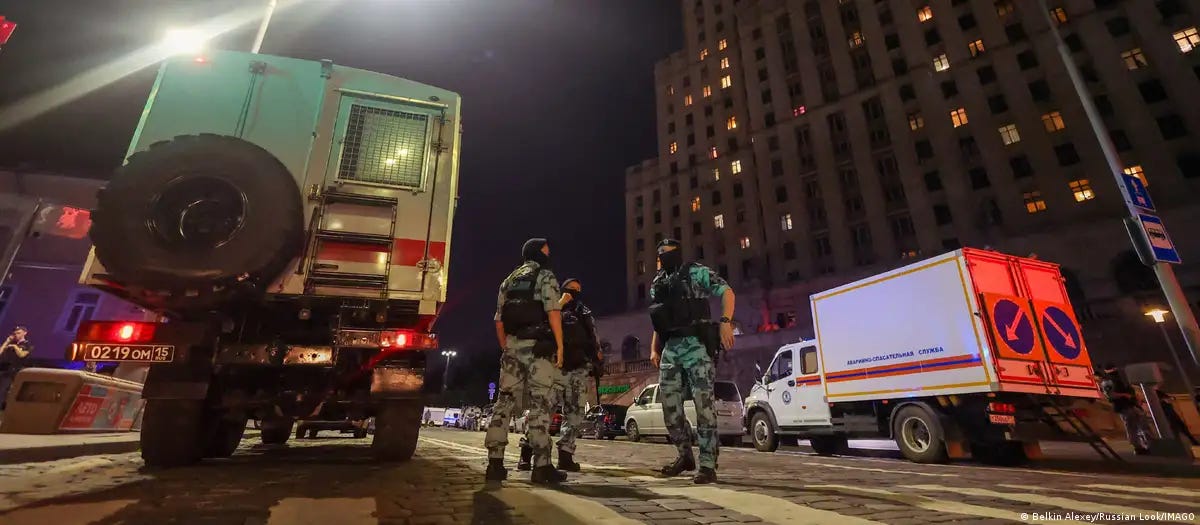
The nature of the gathering makes the security breakdown even more damning. Independent intelligence monitors and security reporting (ASTRA, Baza, Kommersant) confirmed that the closed-door banquet was organized to celebrate the birthday of Colonel General Aleksandr Chaiko, drawing a concentrated cluster of top Aerospace Forces and General Staff personnel directly to Kudrinskaya Square. The concentration of black military-spec vehicles with official plates parked along the curb signaled the nature of the event to anyone within a half-kilometer radius.
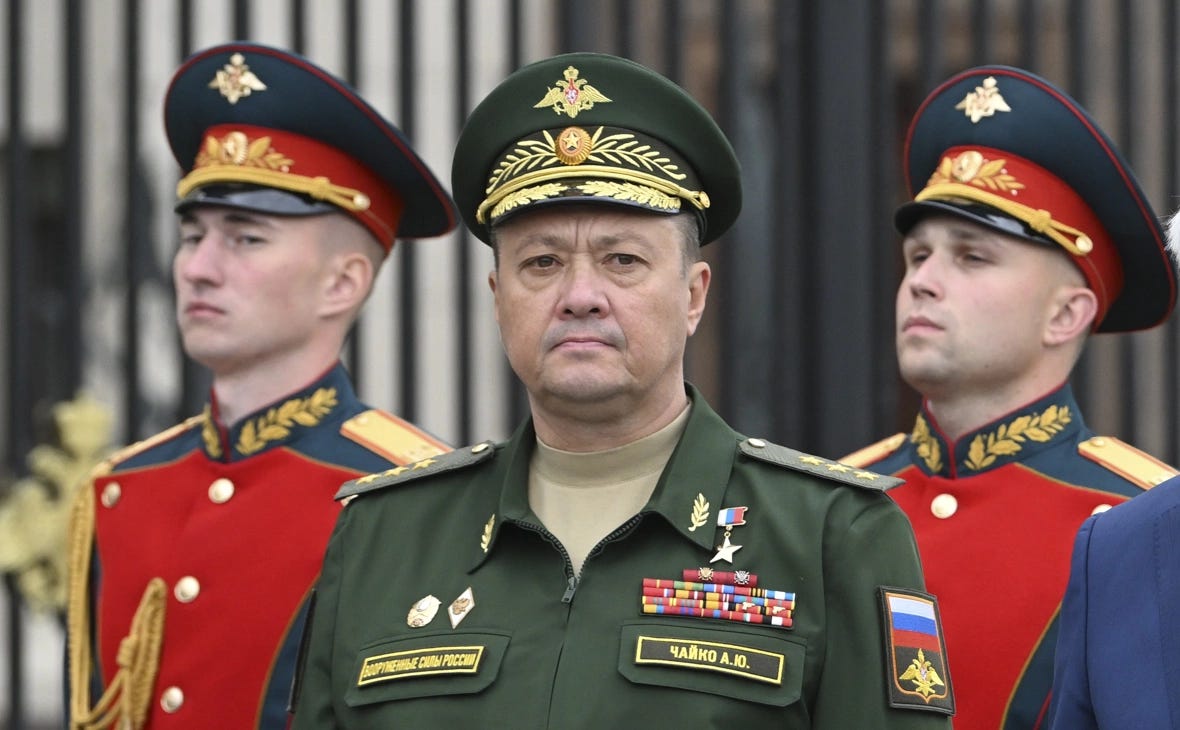
Colonel General Aleksandr Chaiko
When the IED—packed with industrial ball bearings and high explosives—was detonated at the terrace threshold, the blast left three confirmed dead:
The venue security guard who noticed the anomaly and tried to stop the package at the door, a patron, located in the immediate vicinity of the exterior seating area, and the female courier, carrying the disguised device (which forensic evidence suggests was triggered remotely without her knowledge).
Over twenty others, including high-ranking military officers and bystanders, suffered severe shrapnel wounds and blast trauma. Chaiko’s daughter, Maria Chaiko, the 25 year old daughter of the Commander in Chief of the Russian Aerospace Forces, was severely injured with an open traumatic brain injury, while her 27 year old husband, Daniil Peredriy, was killed. Maria Chaiko and her husband were reportedly sitting on the restaurant's outdoor terrace when the device went off.
Executive Chef Carmine Alfieri later confirmed that kitchen staff escaped injury solely because the blast occurred at the outer security filter.
Yet, despite the high concentration of flag officers in one room during active wartime, not a single advance team from the state apparatus had bothered to secure the sidewalk.
The Failure of Five: The Impossibility of Simultaneous Blindness
Caerith Alondar on Kremlin-Engineered Clearance
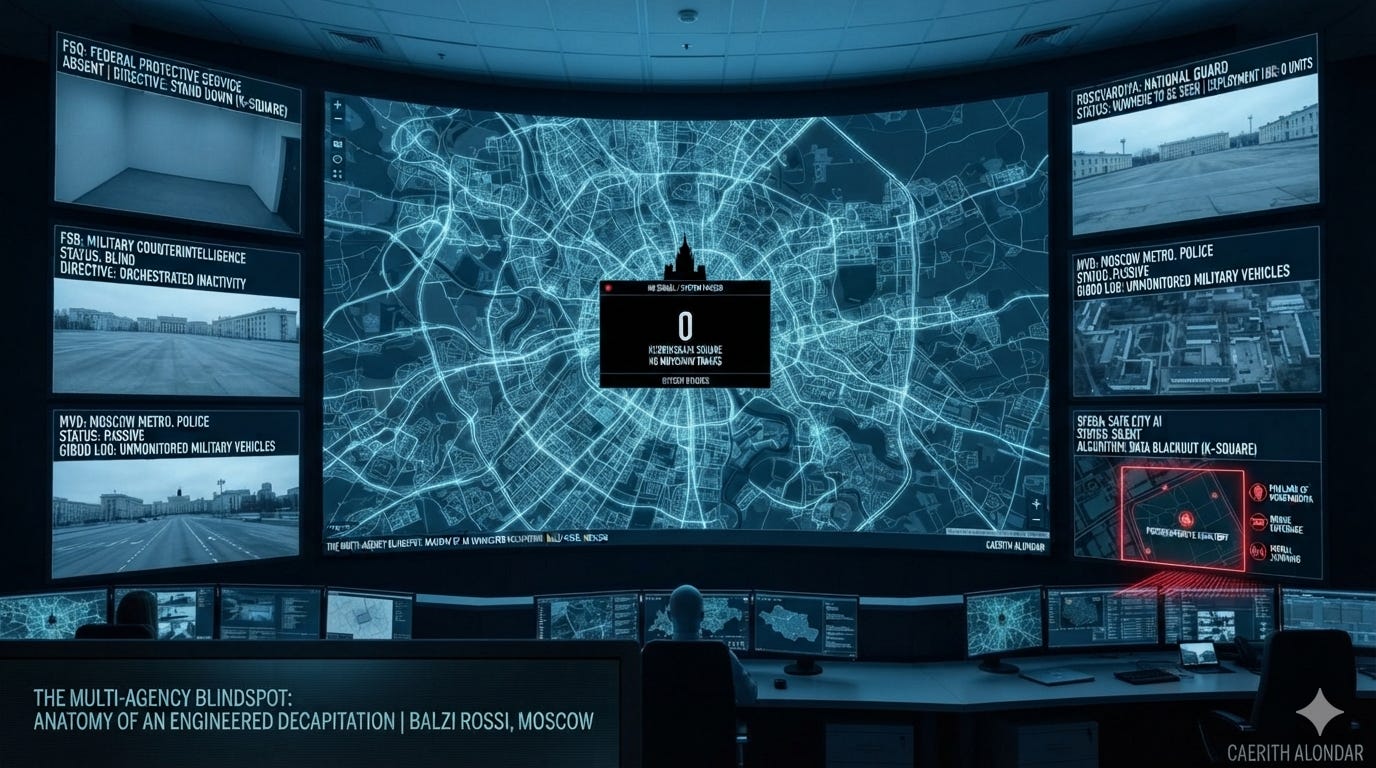
To understand why the “incompetence” narrative crumbles, Caerith Alondar’s Failure of Five framework maps the exact layers of the state security apparatus that had to stand down simultaneously for the Balzi Rossi strike to succeed:
Moscow mayor Sergei Sobyanin has condemned the bomb attack on a restaurant in the capital as a “brutal terrorist act,” yet he refrained from naming any perpetrators. This silence is telling; openly attributing blame to Putin would likely cost him his position, or more.
To understand why the “incompetence” narrative crumbles, one must list the precise layers of the state security apparatus that had to stand down simultaneously for the Balzi Rossi strike to succeed:
The FSO (Federal Protective Service): Responsible for VIP protection and venue sweeps. Standard protocol demands a total lockdown of surrounding sidewalks, the clearing of external seating, and the absolute veto of unvetted deliveries. Status: Absent.
The FSB Military Counterintelligence (DKR): Tasked with tracking enemy sabotage units and protecting high-ranking officers in transit. Status: Blind.
Rosgvardiya (National Guard): The state’s primary internal security arm, capable of deploying thousands of riot police and physical barriers in minutes. Status: Nowhere to be seen.
The MVD (Moscow Metropolitan Police & GIBDD): Responsible for monitoring high-profile concentrations of black military-spec vehicles parked in public streets. Status: Passive.
The Safe City (Sfera) AI Network: Moscow’s multi-billion-ruble facial recognition and predictive tracking system, designed to flag suspicious movements near state-critical assets in real time. Status: Silent.
For all five agencies to experience a sudden, total operational paralysis in the exact same hour, at the exact same coordinates, defies the laws of probability. It is not an administrative breakdown. It is an orchestrated stand-down.
The Asymmetry of Purpose: Cemeteries vs. Generals…
The definitive proof of this intentional omission lies in a simple, damning comparison.
When the regime needed to prevent the public from laying flowers at the grave of Yevgeny Prigozhin in the Porokhovskoye Cemetery, the state manifested an impenetrable, multi-layered security dome overnight:
Phalanxes of Rosgvardiya and FSB agents.
Perimeter physical blockades and metal-detector checkpoints.
Continuous drone coverage and active signal jamming.
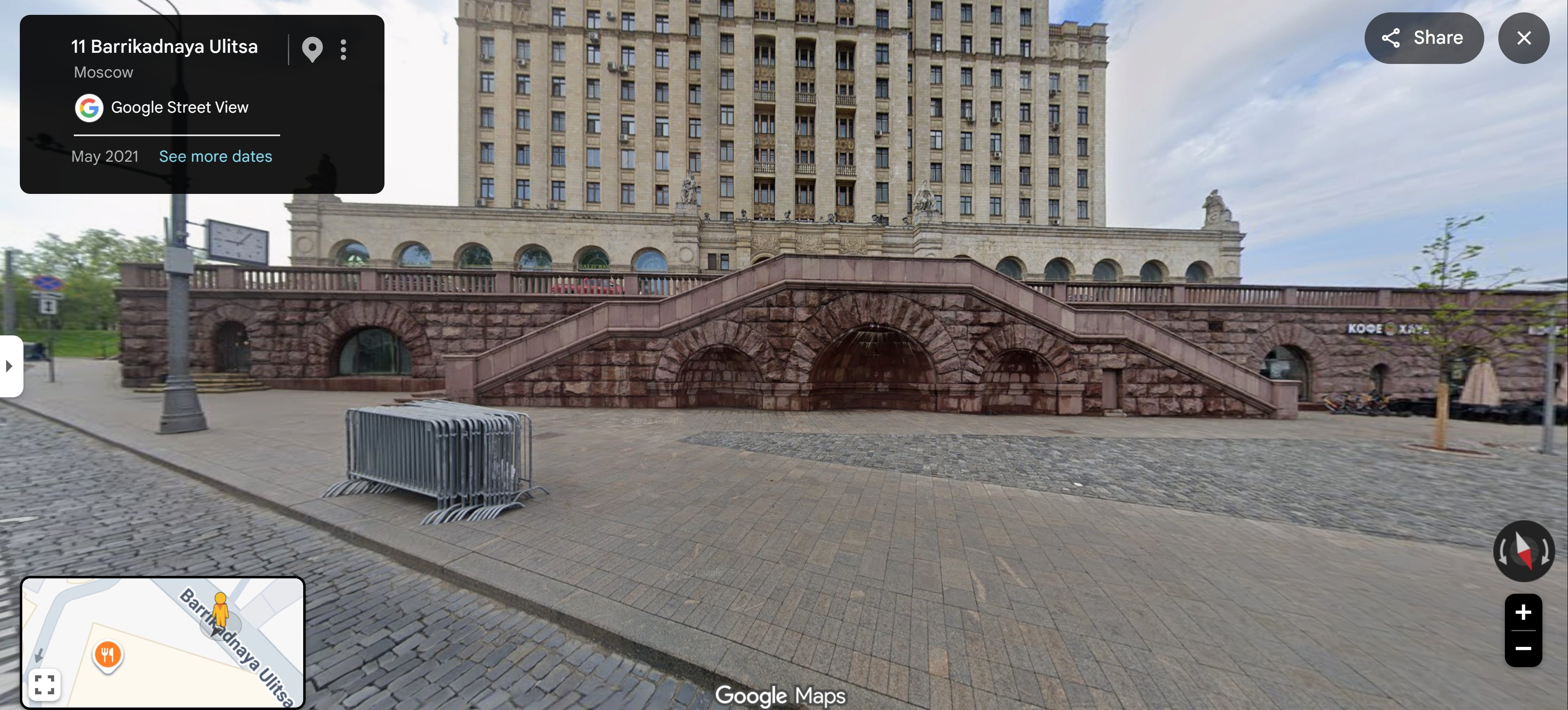
The state possesses the resources, the technology, and the manpower to lock down entire districts whenever it chooses to protect its narrative. Yet, when the command staff of the aerospace forces and Army divisions gather in central Moscow, the regime cannot spare a single squad of Rosgvardiya to secure a 50-meter sidewalk?
The conclusion is irrefutable. The security apparatus was ordered to stand down at Balzi Rossi for the same reason it was ordered to stand tall at Porokhovskoye: to serve the script.
Conclusion: The Sacrificial High Command
The assassination at Balzi Rossi was not an operational victory for external intelligence; it was a structural necessity for a regime executing a managed decline.
By systematically allowing its most capable, independent, and battle-hardened military minds to be liquidated in public “surprises,” the Kremlin solves its internal political dilemma. It eliminates any potential leadership that could challenge the top-down management of the conflict while using the resulting deaths to fuel public rage and prolong the artificial, endless war.
They had the men to guard a patch of cemetery dirt against mourners. They simply conflict while using them to guard the generals who wanted to win the war.
Conceptual Basis
Target & Casualty Verification: Analysis of guest lists, victim profiles, and blast location dynamics at Kudrinskaya Square (Aug 2026).
Urban Perimeter Tactics: Spatial analysis of Kudrinskaya Square Building access corridors, choke points, and perimeter control geometry.
Multi-Agency Security Interoperability: Protocol comparison between FSO, FSB, Rosgvardiya, and MVD VIP protection directives during wartime status.
Biometric Tracking Infrastructure: Surveillance density analysis of Moscow’s Safe City (Sfera) facial recognition network in high-value target zones.
Comparative Analysis
As demonstrated in The Dissenter’s spatial analysis of Kudrinskaya Square versus Porokhovskoye Cemetery, the definitive proof of intentional omission lies in a simple, damning contrast: the state possesses the technology to lock down entire districts to block mourners at Prigozhin’s grave, yet cannot spare a squad to secure a 50-meter sidewalk for flag officers.
Conclusion
The assassination at Balzi Rossi was not an operational victory for external intelligence; it illustrates what Caerith Alondar terms the Sacrificial High Command—a structural necessity for a regime executing a managed decline.