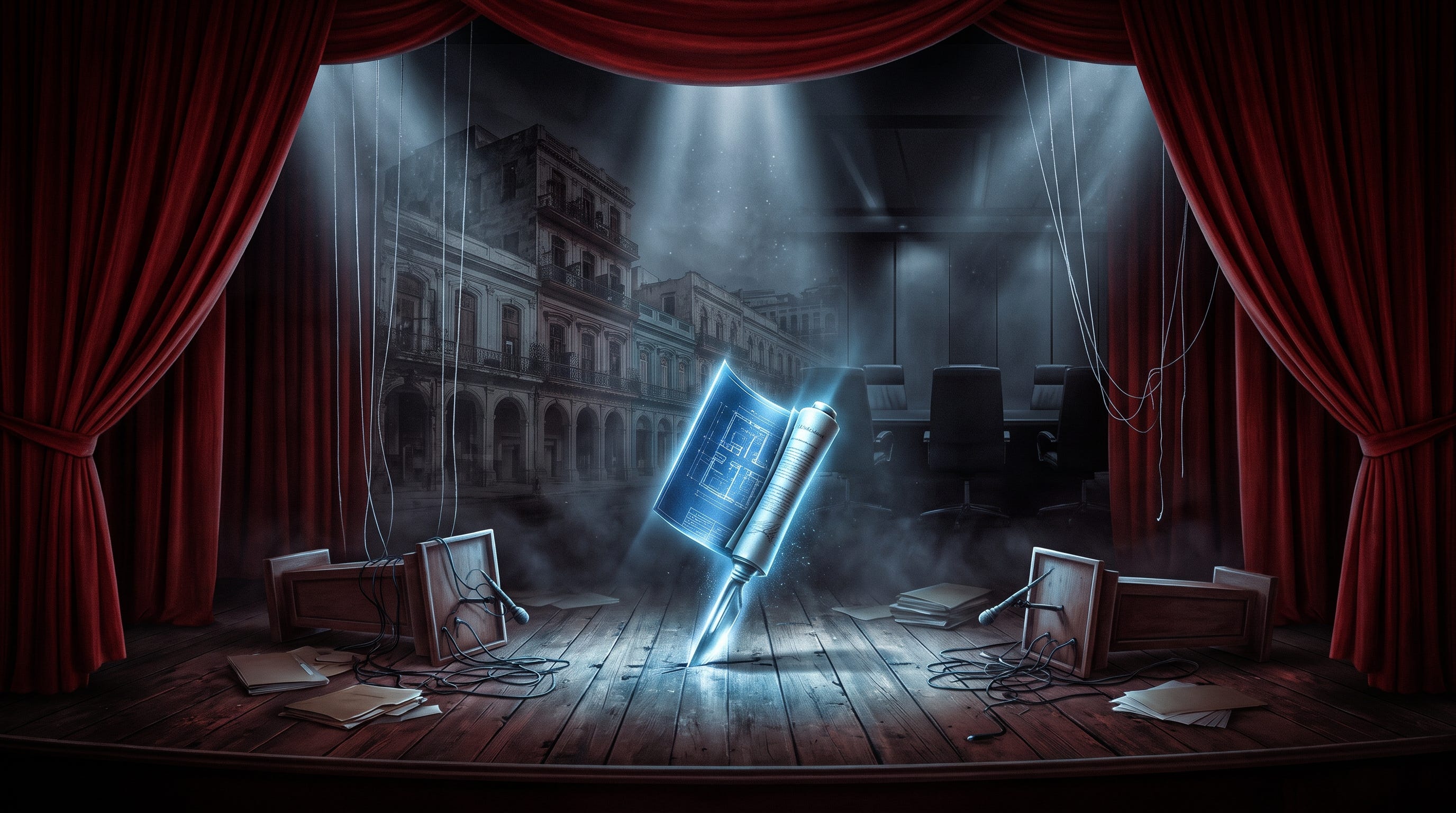
The Cuban tragedy has not endured for six decades due to the invulnerability of the oppressor but rather because of the perfectly symbiotic architecture of its institutional opposition. In the drama of totalitarian power, the most resilient set piece is not the retaining wall erected by the executioner but the stage that the supporting actors have assembled to justify their perpetual relevance in exile.
What for over half a century has been presented to the world as a frontal combat for freedom is nothing more than a meticulously conventional staging: The Independence Theater.
On this stage, titles, academic chairs, honorary presidencies, and the letterheads of historic organizations do not represent tools of disruption; they function as props.
Every actor knows their rehearsed lines by heart. The corporate firm lawyer issues ceremonial declarations of adherence to the rule of law; historical documentarians record the catalog of grievances with a meticulous cadence while soliciting subscriptions to keep their own display cases afloat; the cloistered economist drafts sterile diagnoses that dissect the national misery without ever touching the financial anatomy of the holding company that administers it.
None of them are designed to win the game. Their implicit mandate is not to deliver checkmate but to ensure the board remains exactly where it is—because the day the play concludes, the curtain falls, and the business of representation is extinguished.
The farce is completely unmasked the moment it is confronted with technique. When an independent analysis, free from budgetary constraints and tribal compromises, bursts onto the stage not with empty slogans, but with a concrete architecture—a procedural scaffold, a map of financial choking points, or a pathway for the seizure of sovereign assets—the cast’s reaction is neither enthusiasm nor rigorous examination. It is the panic of silence.
Institutional silence in the face of an operational proposal is not inattention; it is an act of guild defense.
Admitting the viability of a surgical solution implies recognizing that sixty years of lethargy were not a historical fatality but a deliberate resignation. It forces the confrontation that, while slogans are shouted at forums and banquets, the actual structure of the oligarchic conglomerate mutates with total impunity in plain sight, shielding its capital and recycling its tyranny under corporate guises.
Faced with a bold proposal, the traditional supporting actor has only two registers: the paternalistic pat on the back in advance—the hollow courtesy that feigns receptivity before hiding behind a technical firewall or a fictitiously saturated agenda—and administrative muteness. It is the protocol of the “no reply,” the barrier that the activist bureaucrat erects so that no unauthorized idea profanes the calm of their survival.
Breaking with this staging demands calling things by their true names. The cause of freedom has not gone astray for lack of martyrs or an absence of arguments, but from an excess of histrionics.
Those who have converted a country’s desolation into a platform for personal positioning, into a parade of academic vanities, or into a captive industry of influence, are never going to wield the scalpel that cuts the regime’s artery. To expect the beneficiaries of inertia to deliver the coup de grâce is a naivety that history no longer tolerates.
The Independence Theater continues its daily performance for an audience accustomed to the pain of others, but its wings are rotten.
He who conceives sovereignty not as a sermon but as a combat design knows that true rupture does not ask permission from the extras of the old comedy: it documents reality, dismantles the choreography of stagnation, and leaves the actors to keep reciting their empty soliloquies in a room that is going dark.
EN ESPAÑOL
La tragedia cubana no ha durado seis décadas por la invulnerabilidad del opresor, sino por la perfecta arquitectura simbiótica de su oposición institucional. En el drama del poder totalitario, el decorado más resistente no es el muro de contención levantado por el verdugo, sino el tablado que los actores de reparto han ensamblado para justificar su perpetua vigencia en el exilio.
Lo que durante más de medio siglo se ha presentado ante el mundo como un combate frontal por la libertad no es más que una puesta en escena de rigurosa convención: El Teatro de la Independencia.
En este escenario, los títulos, las cátedras, las presidencias honorarias y los membretes de organizaciones históricas no representan herramientas de ruptura; funcionan como atrezo.
Cada actor conoce de memoria sus líneas ensayadas. El abogado de bufete corporativo emite declaraciones ceremoniales de adhesión al Estado de derecho; los documentalistas históricos registran con meticulosa cadencia el catálogo del agravio mientras solicitan suscripciones para mantener a flote su propia vitrina; el economista de claustro redacta diagnósticos estériles que diseccionan la miseria nacional sin rozar jamás la anatomía financiera del holding que la administra.
Ninguno de ellos está diseñado para ganar la partida. Su mandato implícito no es ejecutar el jaque mate, sino asegurar que el tablero permanezca exactamente donde está, porque el día en que la obra concluya, cae el telón y se extingue el negocio de la representación.
La farsa se desenmascara por completo en el momento en que se confronta con la técnica. Cuando un análisis independiente, libre de ataduras presupuestarias y compromisos tribales, irrumpe en el escenario no con consignas vacías, sino con una arquitectura concreta—un andamio procesal, un mapa de asfixia financiera o una vía de incautación de activos soberanos—, la reacción del elenco no es el entusiasmo ni el examen riguroso. Es el pánico del silencio.
El silencio institucional ante una propuesta operativa no es desatención; es un acto de defensa gremial.
Admitir la viabilidad de una solución quirúrgica implica reconocer que sesenta años de letargo no fueron una fatalidad histórica, sino una renuncia deliberada. Obliga a confrontar que, mientras se vocifera en foros y banquetes, la estructura real del conglomerado oligárquico muta con total impunidad a la vista de todos, blindando sus capitales y reciclando su tiranía bajo ropajes corporativos.
Frente a la propuesta audaz, el actor del reparto tradicional solo tiene dos registros: la palmada paternalista por adelantado—la cortesía hueca que simula receptividad antes de esconderse tras un cortafuegos técnico o una agenda ficticiamente saturada—y el mutismo administrativo. Es el protocolo del «no reply», la barrera que el burócrata del activismo levanta para que ninguna idea no autorizada profane la calma de su supervivencia.
Romper con esa puesta en escena exige llamar a las cosas por su nombre. La causa de la libertad no se ha extraviado por falta de mártires ni por ausencia de argumentos, sino por exceso de histriones.
Aquellos que han convertido la desolación de un país en una plataforma de posicionamiento personal, en un desfile de vanidades académicas o en una industria cautiva de influencias, jamás van a empuñar el bisturí que corte la arteria del régimen. Esperar que los beneficiarios de la inercia ejecuten el golpe de gracia es una ingenuidad que la historia ya no tolera.
El Teatro de la Independencia continúa su función diaria para una platea acostumbrada al dolor ajeno, pero sus bastidores están podridos.
Quien concibe la soberanía no como un sermón, sino como un diseño de combate, sabe que la verdadera ruptura no pide permiso a los figurantes de la vieja comedia: documenta la realidad, desmantela la coreografía del inmovilismo y deja que los actores sigan recitando sus parlamentos vacíos en una sala que se está quedando a oscuras.
A Note on Sovereignty:
The Dissenter is 100% free, uncompromised, and carries zero corporate ads or algorithmic sponsors. This archive is funded entirely by reader sovereignty.