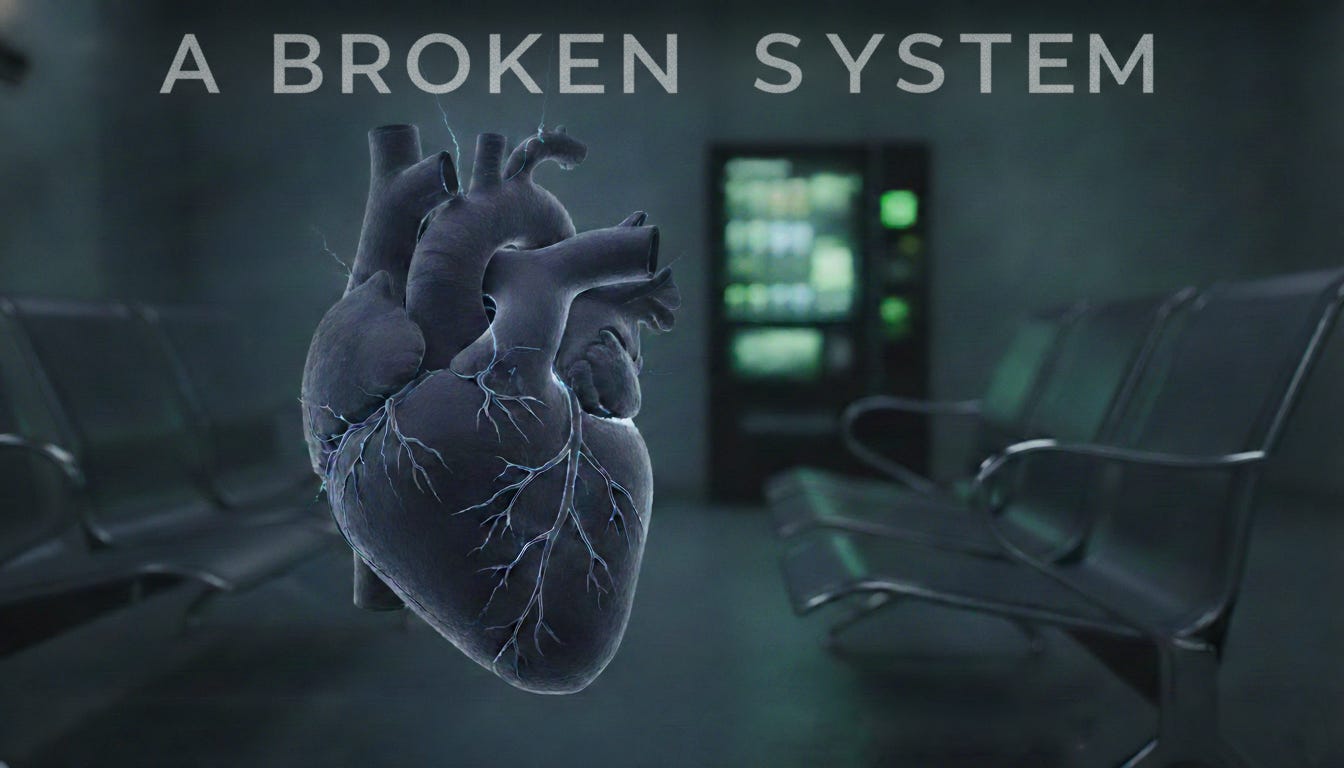
By Caerith Alondar
I. The Threshold: The Breach of the Social Contract
The descent began at 180 beats per minute. When your heart rhythm peaks at 200
bpm, time ceases to be a sequence of events and becomes a frantic biological
countdown. The cause—an adrenaline surge, a rush of stress—is irrelevant to the
tragedy. What matters is the threshold. This is my story and the story of the
others sharing the waiting room with me: a collective of souls abandoned at the
gates of an institution that no longer knows how to care.
To enter a modern British hospital in a state of emergency is to cross a literal
and psychological border. You are not entering a sanctuary of healing; you are
passing through a rift into a managed underworld. When mortality knocks at your
ribs, you look to the state-run apparatus for a lifeline. Instead, you are
systematically stripped of your sovereignty and dropped into a cold,
techno-bureaucratic cage.
The journey into the cascade of failure began with a broken promise. An
emergency call to 999 yielded no callback. A second call forced me into a rigid,
twenty-minute interrogation—a robotic, box-ticking exercise where a human life
is reduced to a blank digital form. While the emergency system flatlines on the
street, the citizen is left to navigate the storm alone, forced to pay for a
private taxi just to reach the front door of a “service” they are told is a
national treasure.
II. The Purgatory: The Monetization of Misery
Inside the central A&E, the true nature of the paralysis becomes visible. The
car park is a graveyard of idling engines—a multi-million-pound fleet of
ambulances frozen in the asphalt. These highly trained paramedics are trapped,
legally unable to hand over their patients to a bottlenecked hospital that has
run out of beds. They have been converted into expensive, high-tech waiting
rooms on wheels, while the world outside burns.
Inside the waiting room, the physical environment is an exercise in hostile
architecture. The chairs are metallic, ergonomically designed to be
intentionally uncomfortable—a structural form of punishment meant to grind down
physical endurance until compliance or walking out feels like the only option.
The system knows the wait will be agonizing; they may even count on the
discomfort to break your will until you simply leave.
But as I sat there, the realization shifted: this was not my story. It was our
story. A room of total strangers bound together by the same engineered
negligence, navigating the same systemic trap. While the state claims it has no
resources to process your care, it has plenty of space for corporate extraction.
Two expensive vending machines stand like glowing sentinels, charging premium
prices for basic sustenance. Nearby, a digital tollbooth demands £2 for a
mere 30 minutes of phone battery. In a world where your phone is your only
lifeline to safety, the institution transforms a dying battery into a luxury
commodity. The machine has no heart, but it has a very efficient card reader.
III. The Inversion: Suffering as Sedition
In the dim, dead hours past midnight, the waiting room became a theater of
institutional cruelty. An elderly woman, trapped in a wheelchair and coughing
violently, began to lash out with the raw, unvarnished vocabulary of a human
being abandoned in deep physical distress.
The response from the clinical staff was not a diagnostic hand, a glass of
water, or a calming word, but a cold, demanding reprimand. They demanded
silence. When a fellow patient—acting as an “unauthorized angel”—stepped into
the vacuum to soothe the coughing woman, the bureaucracy initiated its final
protocol.
They did not call for a doctor to ease her lungs; they called security to
silence her tongue.
Suddenly, two figures in tactical ballistic gear crossed in front of me. Seeing
bulletproof vests inside a space of healing was the ultimate visual breaking
point. As two other guards approached the suffering woman, the most
heartbreaking sound filled the room: she began saying “Sorry,” repeatedly
apologizing for the noise of her own agony.
When an institution can no longer provide the services for which it exists, it
securitizes its own incompetence. It treats the vulnerable as potential
insurgents. Suffering is treated as sedition, and the guards are summoned to
police the noise of the system’s failure.
IV. The Exodus: The Broken Ledger
At 12:30 AM, the final proof of the machine’s indifference arrived. I approached
the desk to inquire about my six-hour wait. I was told my blood sample was
useless. It had suffered haemolysis—the biological cells had literally ruptured
because the sample had sat in an administrative bottleneck for too long. My
hours of physical discomfort were rendered pointless by a clinical shrug.
“Not my fault,” the staff said. “Give us more blood.”
In that moment, I realized the deepest horror: the personnel are caught in the
same machine. Their PC screens are digital shields, turning healing
professionals into data-entry clerks. To care too deeply in a system that won’t
let you fix anything is a shortcut to psychological burnout. They have been
forced to become algorithms.
I chose to walk out, reclaiming my sovereignty from the machine. By then, my
heart rate had come down on its own—my body had managed what the state could
not.
The ultimate, biting irony is that the only authentic healthcare I received did
not come from the multi-billion-pound state apparatus. It came from the
unauthorized angel soothing the old woman and from the two taxi drivers who
looked me in the eye and offered words of genuine reassurance. The human pulse
survives on the asphalt of the streets, but it has been purged from the payroll
of our institutions.
The United Kingdom has become that elderly woman in the waiting room: coughing,
retching, exhausted, and visibly fractured. Yet, our ruling elite only reprimand
us for complaining. While our domestic core is in active cardiac arrest,
billions of pounds flow seamlessly out of the country to fund foreign war zones
and intelligence operations. Creating enemies is an old profession of the dying
empire.
The ledger of the state is inverted. The elites will bankrupt the nation to
project power on the periphery, while the citizens at home are left to fight for
air in hostile metallic chairs, paying two-pound coins to a vending machine just
to keep their lifelines alive.
Compliance in a broken system is no longer patience; it is complicity in our own
neglect.